Thursday, October 28, 2010

Leaf Litter vs. Groundcovers

Eventually, I need to redesign my small front yard. A large silver maple dominates the space, both in terms of its size and the prevalence of its roots. It is at least 50 years old and is so large in circumference that when I hug it, my fingertips aren't even close to touching. The grass doesn't grow well under it and there are so many roots, shrubs and other trees don’t stand a chance.

I've been thinking about planting groundcovers instead of the grass but haven't done anything because I need to figure out how to handle fall leaves. The tree drops more than 20 wheelbarrow loads—yes, I've counted—of golden-colored leaves over the course of two weeks, leaves that I scattered about my garden beds to build soil. (If it's not too wet, I actually enjoy the meditative state one can achieve when raking leaves.) With groundcovers, it's difficult to rake leaves without damaging the plants and I don't want to use a noisy leaf blower.

I subscribe to Horticulture magazine's e-newsletter and this reader question and Horticulture's answer may help me with my leaf litter dilemma.

Question: At my new home there's a large population of vinca underneath some deciduous trees. Do I have to gather the tree leaves off of it this fall, or can I leave them to decompose?

Answer: It is best to remove fallen leaves from atop groundcover plants. If the leaves are left there, they can keep things damp, which is just the sort of condition in which diseases like to grow and over-winter.
To remove the leaves without ripping up the plants, gently use a rake or a leaf blower. You can then shred the leaves with the mulching attachment of the leaf blower or by running over the pile with a lawn mower. Blow them or spread them back over the groundcover. They'll slip down between the plants and decompose to feed the soil—much more quickly and with less risk of disease than whole leaves would.

Monday, October 25, 2010

Fall Harvest

We all know it wasn't a very good year in the Northwest for heat-loving fruits and vegetables, particularly the tomato. I made my way over to my community garden plot with my adorable gold retriever, Barney, last night after work to harvest my bean crop. Lo and behold, I found some ripe tomatoes! While Barney raced off with some of the fallen tomatoes to play with, I harvested ripe grafted Black Krim tomatoes. This variety seemed to offer the most bounty, but Big Boy had the most beautiful—and less fragile—fruit (both were provided by Alice Doyle, Log House Plants. I intend to harvest lots of green tomatoes in the next few days and use them in the yummy sounding recipes offered by Ann Lovejoy on her new gardening blog.

Two varieties of beans were prolific: Scarlet Emperor and Purple Pod. The bush beans I planted didn't perform. Scarlet Emperor offered decorative bright red-orange blossoms, which I imagine tempted our hummingbirds. Turns out they are beans that need to be shelled and are the loveliest color of pink/lavender! I doubt the Purple Pods snap beans will keep their lovely deep, dusky purple color when blanched or cooked, but they are tasty right off the vine and could add color to a salad or relish plate.

I also harvested four small squash, one per plant. I'm pleased I got any at all but I'm disappointed that I didn't get more off the vine (there were more flowers but for some reason they didn't produce fruit).


Now it's time to try planting carrots and parsnips, arugula, spinach, collards, lettuce, Swiss chard, mustard, kale, beets, cabbage, and fava beans for a winter crop. I'm also going to try row covers to manage pests and I might even try building a cold frame for the leaf crops to extend their season.

I'm thankful I don't have to rely on my beginner efforts at food production to feed myself. Viva les farmers!

What performed well for you in your garden this year?

Thursday, October 21, 2010

Réflexions sur Le Tour...

By Gardennia nutii

Most gardeners know that while spring is the most enticing time to plant, fall is the ideal time because cool weather and rain give plants time to "settle in" to their new surroundings. In years past I've loaded up on most of my fall additions at two events: the Hardy Plant Society fall plant sale (one stop shopping), and Le Tour des Plants (touring and visiting nurseries). I'd come to think of these as the 'yin and yang' of nursery visits.

As many of you know Le Tour des Plants did not occur this year, so the 'yang' of my fall plant buying was gone. To honor this event I thought I’d highlight a few of the great experiences I had on Le Tour:

Dancing Oaks Pergola
Touring the display gardens at Dancing Oaks Nursery. - A lecture on 'no water gardens' enticed me to make the trip and I was hooked within 30 seconds of arrival. My gardens still don't come close to resembling their display gardens (see beautiful picture of their pergola in June), but I continue to strive for that level of splendor.

Dryopteris erythrosora
Meeting Maurice Horn at Joy Creek Nursery - I decided to throw the dogs in the car and go for a drive one rainy 'Le Tour' day. He spent hours helping me find new plants for the foundation areas around my house and played happily with my dogs while doing it. He suggested planting Dryopteris erythrosora among the Heucherella 'Sweet Tea' plants I picked up from Terra Nova Nurseries. What a great combination!


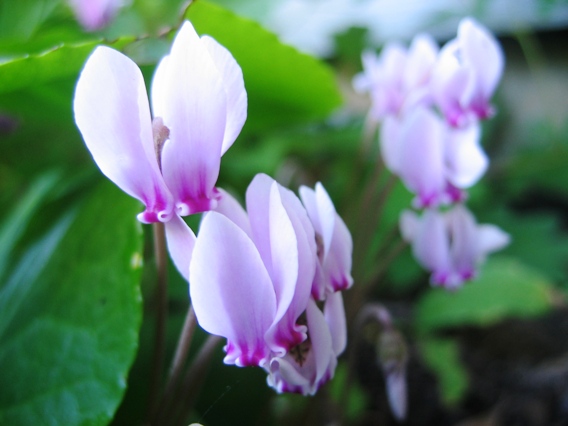
Cyclamen hederifolium
Discovering Green Gate Nursery - A small but amazing nursery in West Linn, owners Anthony and Julie Bernert helped me select plants for dry shade that provide year-round interest. Just look at this beautiful Cyclamen hederifolium that started blooming a couple weeks ago and will bloom until spring!

Le Tour taught me the wonder of visiting nurseries and meeting nursery owners in their "element." With that said, I think I'll go visit some new nurseries, make new friends, and find some more wonderful plants for my fall planting fun.

What wonderful nurseries have you discovered? Let us know!

Monday, October 18, 2010

Looking Good

Many plants are still looking great in my garden. Because fall is my favorite season, I have selected many plants that peak in autumn. I thought I would share a few with you (these photos were taken the first week of October).

Send us photos and the names of plants that are showing off in your garden at this time of year. We'll share them with readers.

Comfort Plants

Macaroni and cheese comes to mind when I think of comfort food. For some reason, when I walked past this amber chrysanthemum on a morning walk with Barney, my adorable golden retriever, it hit me that this was one of my "comfort" plants. It's not a fancy plant. Nor do I know anyone that raves about the fragrance of chrysanthemums.

I grew up with this variety and relished the time when it bloomed. As a garden-loving child, I thought about all the fancy chrysanthemums I wanted to grow, particularly the spider varieties. Though I never followed through on my grandiose plan, this old fashioned variety was planted in my little garden plot. To this day, I can conjure its scent and color, which to me is the epitome of fall.

Do you have a "comfort" plant?

Friday, October 15, 2010

Fragrant Memories

Humans can distinguish about 10,000 different odor molecules. Research seems to indicate that we learn to like and dislike various odors based on the emotional associations we make upon our initial encounters with them, yet...

Our culture places such low value on olfaction that we have never developed a proper vocabulary for it. In A Natural History of the Senses, poet Diane Ackerman notes that it is almost impossible to explain how something smells to someone who hasn't smelled it. There are names for all the pastels in a hue, she writes—but none for the tones and tints of a smell.

Except from The Mystery of Smell: The Vivid World of Odors by Maya Pines

At this time of year, most people are waxing poetic about the colors of autumn, reveling in the sense of sight. Yet another sense is tugging at me: fragrance. Gardening is for all the senses and fragrance is one of the most powerful for me. I showed my new neighbor who is new to gardening two weeds that he should keep in check: Bittersweet nightshade and Herb Robert geranium. To help him remember, I crushed their leaves and offered them up for him to smell.

As I was walking the neighborhood, the immediately recognizable scent of Clerodendrum trichotomum (Harlequin Glorybower or Peanut Butter Tree) caught my attention. The one in my yard had already stopped blooming and was sporting its red bracts and blue fruit. I planted it because I love its fragrance, which perfumes the vicinity (my neighbor Shelley commented that she enjoys the fragrance when she sits on her deck). How do you describe the luscious scent to someone that hasn’t smelled it before?

Phlox are still blooming in my garden, though probably not for long. Their subtle scent is comforting for some reason. Perhaps a wonderful childhood memory is the reason.

As the garden winds down for the winter, there are two scents I’m eagerly awaiting, both harbingers of spring: Sarcococca confusa (Sweetbox) and Daphne odora. Sarcococca’s potent yet light scent comes from surprisingly small, fringed white flowers tucked along its stems. The fragrance of daphne, on the otherhand, is a powerhouse of odor molecules; even several flowers in a confined area can be overwhelming. Yet, walking past the shrub near my driveway or the one by my garden gate is a taste (or scent) of heaven. I can’t describe the scent to myself let alone to someone else. But it’s embedded in memory; pleasant ones, I might add.

What do pleasant scents from the garden conjure for you?

Thursday, October 7, 2010

Pumpkin & Farm Events

Oregon is blessed with wonderful autumns and a robust farming community. Marry that with retail nurseries and you have a slice of heaven (and lots of fresh apple pie!). Kym Pokorny and I headed to Bauman Farms & Garden with our adorable dogs Molly (hers) and Barney (mine) to take a look at the giant pumpkins (that's Barney in front of one of the "smaller" giants). We also came back with a trunk load of pumpkins and decorative—but also tasty—squash. The biggest giant topped out at 1360 pounds and was the winner of a $10,000 prize (funded by Bauman's Farm, I came to find out). That's a hundred pounds lighter than last year's due to our cooler weather this year. Brian Bauman said, and I'm assuming I heard him correctly, that a single seed of a record breaker can sell for as much as $800!

On a garden writer tour in Oklahoma, we visited a residential garden where the owners had piled a variety of pumpkins and squash at the base of a tree. It was very decorative and something I've thought about doing. Unfortunately, I didn't remember that until I arrived home with not nearly enough gourds to accomplish the task. Next year...

Treat yourself and the kids to a great day on the farm and find the perfect pumpkins for carving and decorating by visiting these retail nurseries. Have fun!

Bauman Farms and Garden (Gervais) – Pumpkin Patch through October 31. Admission fee. Activities include hay rides, zip lines, animal barn, giant slides, mazes, straw castle, apple and apple cider tasting, pedal carts, climbing wall, and more. Don't forget to stop in at the bakery, farms store and garden center. www.baumanfarms.com

French Prairie Gardens (St. Paul) – Harvest Festival through October 31. Admission fee. Activities include themed weekends for military appreciation, grandparents, high school spirit and cruise-in (classic cars), and pumpkin patch, hay and corn mazes, obstacle course, hay slides and more. They also offer fresh produce and baked goods. www.frenchprairiegardens.com

Smith Berry Barn (Hillsboro) – Apple Festival, October 16 & 17, 12-4pm. Activities include heirloom apple tasting, tasty apple treats, press your own cider, live music, wine tasting, u-pick apples (this weekend only), visiting alpacas and more. www.smithberrybarn.com

Wooden Shoe Bulb Company (Woodburn) – Pumpkin Fest through October 31. Admission fee. Activities include corn and hay mazes, pumpkin cannon, paintball gallery, calf roping, hay rides and slides, wheat grinding, Halloween Hauntings (on select days), and more. www.woodenshoe.com