Wednesday, December 29, 2010

Let Them Go Green....Again?

By Gardennia nutii

What to do with those holiday poinsettias? How about letting them go green just in time for the St. Patrick’s Day holiday? This is the exact sentiment I had a few years ago, a sentiment much to the dismay of our neighbor’s kid who sells poinsettias every year to raise money for his soccer team. My experiment to keep these plants past the holiday season and let them grow naturally lasted almost two years – that is how long it took for them to grow into leggy, scraggly plants which were no longer worthy of my prime in-house real estate.

Well...I’m back to square one. I bought poinsettias to support kid’s soccer, and now that the holiday season is coming to a close I find myself with beautiful plants I can’t seem to toss. Do I learn from my past experiment that yielded leggy plants? Or do I run the experiment all over again with new knowledge? I haven’t made up my mind, but in the process of weighing my options did a bit of research on poinsettias and learned some fun things:
  • Poinsettia is actually Euphorbia pulcherrima. As a plant in the genus euphorbia, take care not to overwater and use caution when handling the plant because the white sap can be irritating to the skin and stomach, and can cause temporary blindness if it gets in your eye.
  • In its native Mexico habitat, it is a shrub or small tree reaching two to 16 feet in height. If you want to see poinsettias grown in the wild visit this site: www.explorelifeonearth.org/poinsettia.html.
  • The colored bracts you see during the holidays come as the result of triggering a photoreceptor protein which requires at least 12 hours of darkness at night, and the really bright bracts need a lot of light during the day to reach their prime color.
  • The Ecke family had a virtual monopoly on poinsettia production in the U.S. until only about 20 years ago. The reason for their monopoly was due to a secret which yielded a fuller, more compact (and more desirable) plant. This was done by grafting two varieties of poinsettia together.
This last tidbit is something to keep in mind if you plan on keeping your poinsettia as a more permanent house plant, something I didn’t know when beginning my experiment a few years ago. I cut my plants back as they aged to encourage a bushier form, but I now know that in cutting them back, I most likely took off the grafted (more desirable) poinsettia and left the natural plant to grow. So the leggy plants that resulted were ‘oh natural’.

Thanks to the Ecke family, the many growers who produce these holiday treats and the local kids soccer funding needs, I’m once again facing my holiday conundrum: to compost or to let it grow? I still don’t know the path I’ll choose, but its fun contemplating the possibilities.

What do you do with your holiday poinsettias? Let us know!

Monday, December 20, 2010

Let Playing Dogs Roll....

By Gardennia nutii
I’ve learned to embrace unintended consequences. For example, the lovely flower show that resulted when Prunella vulgaris took over my lawn after I neglected weeding chores. Another wonderful unintended consequence occurred the first weekend in December when heavy winds blew the last of the delicate leaves from my laceleaf Japanese and vine maples off walking surfaces and into my flower beds. They now offer a protective covering during the winter and as wonderful mulch as the seasons progress.

Shredded sweet gum leaves used
as mulch under a rhododendron.

I’ve always been a big proponent of letting leaves provide natural mulch, especially because I have so many trees with delicate leaves that compost quickly and don’t smother my bedding plants. However, I do have one tree with very large, heavy leaves that drop late in the winter: my beloved sweet gum. What to do with all those thick, heavy, wet leaves that smother plants if left in place? In the past, they usually ended up on the compost pile, taking years to break down.

Thanks to an unusually dry weekend, I was able to try an experiment: using the lawnmower to shred the dry leaves then directly using them as mulch. So after collecting as many sweet gum leaves as we could, my husband fired up our very un-environmentally friendly mower to chop up those leaves. It took several passes since these leaves are so heavy and thick, but we got the work done in no time thanks to that mower.

Spreading the shredded leaves was made even easier due to three cheerful canine helpers: Archer (our dog) and Max and Jack (our neighbor’s dogs). They enthusiastically spread the piles of chopped leaves while rolling and playing in the yard.

Thanks to a little wind, dry weather, and active dogs, I now have my planting beds tucked in for the winter. Sigh...another task done.

Do you have a great way to recycle your leaves? Let us know!

Wednesday, December 8, 2010

Gifts for Gardeners

As I write this, there’s still a week and a day before December arrives. Has this year flown by as quickly for you as it has for me? It’s the gift-giving time of year and there are lots of lists to offer help for the weary. But I wanted to offer a few suggestions that might offer cheer at any time of year to the gardening friends and family with whom we surround ourselves.

1. Membership in Hardy Plant Society of Oregon – provides access to HPSO member open gardens almost year round , excellent programs, early plant selection opportunities at the twice annual sales for volunteers, discounts at participating nurseries, and discounts on gardening books.

2. Support Hoyt Arboretum – in the words of President Theodore Roosevelt: “To exist as a nation, to prosper as a state, and to live as a people, we must have trees.” Your donation helps maintain and operate a living museum, which is no small task.

3. Gift cards and certificates from your favorite garden center or a gift of your favorite plant.

4. The WSU Extension Master Gardener Program offers a comprehensive, science-based, how-to manual designed for gardening in all areas of the Pacific Northwest. Textbook quality in terms of its science and scope, the 640-page publication is binder ready and features full-color photographs and diagrams throughout. Chapters cover all aspects of horticulture and gardening, from basic botany and soil science, to forestry stewardship, integrated pest management and garden planning. Copies may be ordered at http://www.pubs.wsu.edu/ or by calling 800-723-1763. The cost is $100 plus shipping and handling.

5. Gloves, gloves and more gloves

6. Support Growing Gardens and other organizations helping people learn how to feed themselves and others.

7. Instead of a book club, organize a gardening group made up of friends. The goal is to help in each other’s gardens. It makes lighter, faster work with the added benefit of spending time with people you care about. Devote 2 hours (or more) a month, rotating gardens every month. Just think about the fun projects or weeding you can get done!

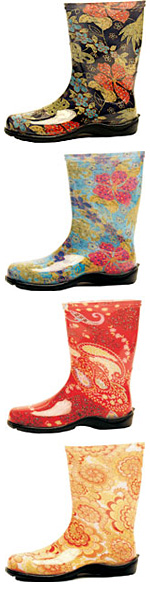
8. Flowered rubber gardening boots – I discovered Sloggers at the Newport Garden Expo in Heirloom Roses’ booth. They also offer them in their St. Paul gift shop. I now have a tall pair and shorter version and love wearing them in the garden, walking the dog, going to the grocery store, etc.

9. The Best at Dianne B for this bloggers’ top gifts for gardeners. The English garden twine and plant markers look particularly interesting to me.

10. A visit to Red Pig Tools in Boring, Ore. with your favorite gardener can be a winner. Hand forged and other well-made tools abound. The owners will even show you how to use your shovel correctly; the instruction has been a back saver for me.

11. Give the gift that keeps on giving: Heifer International’s gift of bees (or a trio of rabbits, flock of chickens, gardener’s basket, or earth basket). Provide a family a livelihood while adding healthy foods to their own diets and those of their community. Heifer's mission is to work with communities to end hunger and poverty and care for the earth.

12. Offer to sharpen your friend’s gardening tools. This is something that I never seem to get to and it would be a welcome surprise.

Share your gardener gift suggestions with us.

Wednesday, December 1, 2010

Turning Ordinary into Extraordinary

There’s still a lot to see in the garden at this time of year. Many of us are a little burned out with all the gardening we’ve been doing since spring and we just want to sit back and relax. Well designed gardens offer year-round interest, the beauty of which can be a distraction from our gray days (in fact the gray skies often enhance the brilliance of leaves and flowers…so gray days are blessings, right?!?). I’m amazed at how well hydrangeas performed this year and they offer quite a bit of color and garden interest. As of November 21, my fuchsias were still blooming (what a gift!). Some fiery-colored Japanese maples are tenaciously holding their leaves, as are the gum trees; this is true of my—what I believe to be—Acer palmatum ‘Seriya’. Pyracantha and cotoneasters also are offering colorful leaves and/or fruit. And don’t get me started on confiers! Blues of spruce and fir; deep greens of hinoki, firs and yews; and chartreuse of Cupressus wilma, a lemon-scented conifer add color and structure to the garden year round. There’s a surprisingly long list of plants that should be features in the garden at this time of year. And it’s a great time to visit garden centers and nurseries to select plants that are late fall and winter standouts. (All photos taken Nov. 21, 2010.)


Share with us the plants you find extraordinary at this time of year.

Mushroom Hunt a Success!

Our Random Acts of Gardening mushroom adventure (see the November 1 post) converted seven gardeners into mushroom explorers. Steve Schmidt, Sustainable Consulting LLC, started us with a lesson in using a compass and edible mushroom recognition before heading into the Mt. Hood National Forest. Hedgehogs—including the largest one Steve’s ever seen, a whopping 6 inches in diameter—were the first edible mushrooms spotted. Then the Chanterelles obliged, including whites and Yellow Foot. As we started to head back to the cars, I heard whoops and cheers as the group stumbled upon a host of Lobster mushrooms poking through the forest floor. Then there were the jelly mushrooms, which look like translucent jelly fish and edible though essentially tasteless; Steve says you can use them in fruit salad but I tossed mine after tasting them.

While Random Acts of Gardening won’t be offering another mushroom adventure any time soon, Steve hosts private and group tours. The season is done for this year but morels start popping in spring. To arrange your own guided mushroom tour, contact Steve at 503.637.3095 or sschmidt@rconnects.com.

I’m looking forward to making creamy Chanterelle pasta and a Velvet Chanterelle soup recipe Steve shared with the group!