Thursday, February 24, 2011

The Best Garden Ideas

Garden shows are good for sparking the imagination and getting us to re-imagine our garden spaces. The Yard, Garden & Patio Show wrapped up on Sunday. As one of the OAN staff working on the show, I took a few minutes on Sunday to snap photos of the things I was most inspired or intrigued by. Here’s just a few. If you attended the show, let us know what most inspired you.

I’ve tried—and failed—to design a container with year-round interest for my front door step. I’m thinking I should just make the investment and buy something a professional has created. These two containers by Dennis’ 7 Dees caught my eye. One has the rich warm tones I love; the other great texture (I’m not wild about spiky plants, but this could change my mind).

I love woodland ecosystems and have been intrigued by an emerging trend: stumperies. This display designed by the ever imaginative Laura Crockett for Landscape East & West’s booth, takes stumperies to a new level. Water dripped ever so gently from the fern island, which was raised just a few inches from the geometrically-shaped pond.

Speaking of water, there were many water features at the show, from the biggest dramatically lit, still pond to the simplest bird bath. These two fall somewhere in between. All Oregon Landscaping does wonders with concrete in this feature, adding color and texture with a unique concrete casting method. Their plant selection and green wall design enhanced the display. On the simpler end of the spectrum is the rock that, instead of bubbling out the top of the rock, has the tiniest of rock ledges to create just enough trickling water to distract the ear and pull me to its location. It was created by Bo Lassiter Stonescapes.


Fire pits and fire places continue to be all the rage for outdoor living. Created by Dennis’ 7 Dees Landscaping, this is a blend of both: laid stone creates the enclosure but leaves natural openings for air circulation, and gravel, pebbles and rock create the hearth. [A word of caution about open air fires: the smoke can aggravate asthma so please be considerate of family, friends or neighbors that suffer from the disease.]

Stone plays an important role in defining space. It also helps us slow our journey and contains our garden beds. But these two uses of stone add drama. Enviromax Landscaping & Design combined different stone texture and shape in their showcase garden. The floating rectangular blue stone was flush with the water causing those that stepped across to wonder at their expectation that the stones would sink or tip. Talk about forcing awareness of one’s surroundings! Kristine Hanson and Autumn Leaf Landscaping stacked drilled rounded rocks to create a striking sculpture.


Fencing doesn’t have to be relegated to the periphery of your property. Landscape designer Kristine Hanson designed this moongate to create a multi-dimensional effect, which focuses attention on the beautiful glazed container. It could also work to emphasize a special piece of garden art or specimen plant.


Stone isn’t the only material to keep an elevated garden bed in place. Barbara Simon and Dinsdale Landscape used architectural salvage to elevate and add interest to this garden space. That and the beautiful woodland lantern added a mysterious element to their design.


Imagine using panels created by Gina Nash on gates, pergolas, fences as art, rain barrels, screen doors, etc. These whimsical carrot panels were created for the Incredible Edible Garden making the garden space very special indeed.

I’m heading to the Northwest Flower & Garden Show for more ideas.

Wednesday, February 16, 2011

Spring Gifts for the Garden

This is the third and final installment of favorite spring plants my gardening and nursery friends shared with me. I hope you’re inspired to give something new a try (look at the grape hyacinth!) or find a spot for something that’s been in the nursery trade for awhile, because you can’t go wrong with Sarcococca and Dawn Viburnum. Enjoy spring! I hope your garden brings you a plethora of joy.

Kate Bryant, Kate Bryant Gardening LLC and Portland Monthly’s garden blogger – This unusual grape hyacinth (Muscari macrocarpum 'Golden Fragrance') has a completely irresistible and powerful scent that tantalizingly fuses gardenia with sweet, candied tropical fruit! To capture the fragrance and keep it close, grow them in small terra cotta pots. Long, slightly twisted, blue-green leaves will appear, looking dapper and interesting over the winter. Bring pots indoors around late-February: fat spikes will emerge, developing into spires of tubular florets the color of slightly green bananas, topped with a crown of smoky purple florets. The effect is captivating! You can also plant them in clumps outdoors (they thrive in a warm, sunny spot and are cold-hardy to Zone 4), where they flower at the end of March/early April. Don't forget to pick a few blossoms to enjoy indoors. Muscari macrocarpum 'Golden Fragrance' is often available at garden centers in spring in pots, as well as bulbs in autumn.

Mike Darcy, In the Garden with Mike Darcy on 750KXL – Garrya elliptica ‘James Roof’ (common name is Coast Silk Tassel) is a large, evergreen native that is easy care once established. It needs little or no water, takes sun and also some shade, and offers cream-colored 10-inch long blooms. What’s not to like? It’s a great evergreen shrub even for a small garden (it is easily pruned).

P. Annie Kirk, Red Bird Design – Requisite for certain is Viburnum 'Pink Dawn' (Viburnum x bodnantense 'Pink Dawn'). A close second is Ms. Jelena Witch Hazel (Hamamelis x intermedia 'Jelena'). Then for a little secret scent attack - bam! - fragrant Sweet Box (Sarcococca ruscifolia). For a great bridge and relentless 'pop', I like a spring sprinkle of Evergold Carex (Carex oshimensis 'Evergold').


Linda Shively, Farmington Gardens and YGP Exhibitor (Booth #978) – I love Daphne odora ‘Marginata’ for many reasons. First of all, it is a broadleaf evergreen shrub, so it holds it gorgeous variegated leaves all year long. I really love that in the winter. But then in early spring (or late winter) it begins blooming with the most sweet-smelling blossoms. It will get to a mature height of 3-4 feet, with a slightly wider spread, making it a nice-sized shrub. It can be just little a sensitive to transplanting, so decide carefully where you will put it so it won’t have to be moved. It likes good drainage and a bit of afternoon shade. Ideally, you want to place it where you walk by it every day so that you get maximum enjoyment out of the fragrance! One of my favorite things in spring is to bring a few sprigs into the house.


Peter Eastman, Fairdale Nursery – Magnolias, magnolias magnolias! They are the Queens of the early spring garden. There are so many to choose from, old stand bys to brand new hybrids. If I had to narrow it down, here’s the list: Magnolia ‘Vulcan’ is still the best flowered magnolia on the market for pure richness of color and great form. ‘Vulcan’ is one of several wonderful magnolias from Mark Jury in New Zealand. I am always in awe of the pure ruby color on this selection. When it is in flower it stands out like a neon sign. The tree maintains a nice pyramidal form and can be used as a small street tree to great effect. This selection flowers at quite a young age. Other favorites include Magnolia maudiae, Magnolia ‘Caerhays Belle’, Magnolia ‘Lolanthe’ and Magnolia denudate.


Sarah Smith, The GardensmithRhododendron ‘Snow Lady’ (R. leucaspis × R. ciliatum) is one of my favorite shrubs. It looks great year round with bright olive green leaves covered in little hairs that shout out “fondle me!” It has small white flowers which in my Milwaukie garden bloom in early March. It is a small grower, about 3-4 feet tall and wide, and will bloom well in bright shade. The only drawback I see to it is if we have a hard freeze in late winter, flowers can be lost, but the foliage still looks great.


Anne Taylor, Living Elements Landscape and designer of the YGP beverage gardens – Euphorbia x martinii 'Ascot Rainbow' looks great all the time, even in winter. The only time it looked not so great was during the week of cold. The plant looked cold. When it warmed up, it looked like it never missed a beat! I have had this plant for two years (it was one of the new plant varieties) and it is fantastic! Another early plant I LOVE is the snow drops (Galanthus nivalis); they make my heart weep, they are so tender, sweet, lovely, and strong to make it and push themselves up so early in the year.

Tuesday, February 15, 2011

The show starts Friday!

All the volunteers and staff at the Oregon Association of Nurseries are thrilled to bring you the 2011 Yard, Garden & Patio Show. Check out the time lapse video of the Showcase Gardens coming together. It's an amazing process and we hope you, your family and friends enjoy the results.

High Tech Beehives

The bees have been busy in The Oregon Garden’s four hives and they have 300 pounds of honey to show for it.

“It’s an exceptional feat to have just four new hives produce that quantity in the first year,” said Mark Thompson, who manages the new beekeeping program at The Oregon Garden. Thompson attributes much of the success to “solar beehive cooler” attachments that literally take the heat off the bees and help them to be more productive.

During the summer months, when the bee colonies are most active, bees assign certain workers to sit at the bottom of the hives and fan their wings in order to cool down their environment. But when the solar-powered coolers are attached to the hives, thermostatically controlled fans click on at a pre-set temperature, thus liberating more bees to collect pollen and make honey. In addition to cooling the hives and promoting honey production, the solar cooler attachments are also supposed to result in fewer hive mites and calmer bees. “This technology isn’t yet widely used,” added Thompson. “I learned about it in a bee journal and was cautious at first, but it has really proved to be effective.”

Thompson also attributes the success of the hives at The Oregon Garden to the abundance of early spring flowers and varieties of pollen available there for the bees. “We initially weren’t sure what to expect from the quality of the honey because sometimes a huge mix of pollen types can create flavors that are bitter or mediocre,” Thompson said. “Happily, the honey turned out really well. It’s a lighter style with pleasing floral notes. It’s truly a taste of The Oregon Garden.” Beginning in February, The Oregon Garden Visitors Center is selling 12-ounce jars of the “Oregon Garden Honey” for $7.95.

The Oregon Garden’s beekeeping project began more than a year ago when the horticulture staff sought to establish a “bee education” program with informative signage and resident bee colonies. The garden expects to add two to four additional hives this spring.

Now in winter hibernation mode, the hives are kept in The Oregon Garden’s Oak Grove, where nearby educational signage informs visitors about the lives of honey bees as well as the rampant “colony collapse disorder” (CCD), a mysterious bee disease spreading among hives throughout the country. Binoculars are available for visitors to get a better look at the hives.

“The honey makes a great souvenir for visitors to The Oregon Garden, and is also a wonderful gift idea for those seeking something locally made,” said Jeff Pera, assistant horticulture manager for The Oregon Garden. “We look forward to seeing this program evolve.”

EarthPot®

By the makers of EarthPot®


“At Landscape East & West, we love the EarthPot! They are quick to plant, there’s no plastic pots and mess to pick up after the job is done, and the plants establish faster with no transplant shock!”
- Cody Plath, Landscape East & West, Clackamas, Ore.

To gardeners, few things are more rewarding than working in the garden. We love the colors, smells and unlimited possibilities of creating a personal masterpiece with our own hands.

Before adding plants to the garden, we typically have to do some prep work, including removing the plants from the—most often—plastic pots and ensuring the roots are loose and ready for planting. If a plant has been in a pot for a while, it may have circling roots, which are easily recognizable and put the plant’s long term survivability at risk. Sometimes it’s necessary to slash the roots and massage them free from one another. This prep work may be annoying to us, but it’s more annoying to the plant and often delays future growth as the plant re-establishes its root structure. And we have to take care of the plastic pots, hopefully recycling them and worse case, throw them away.

There is a new alternative to the pervasive plastic nursery pot: The EarthPot®. The EarthPot is a soil media in cellulose (plant based) wrapper. Made locally, the outer fabric wrap takes the place of the plastic pot. You plant the EarthPot and its wrapper directly into the soil. Roots grow right through the fabric and are stronger because they are air pruned, promoting more root branching and a more fibrous root structure.

“I love the EarthPot! They are easy to work with and I don’t have a lot of pots to clean up when I’m finished planting. I guess I’d say they make working in the garden more fun!”
- Shelley B., homeowner and gardener, Tacoma, Wash.

EarthPots are faster to plant and take less time to clean up; plants will not experience transplant shock because the roots aren’t disturbed; and you will do your part to cut down on what goes into the landfill.

Editor’s Note: To learn more about the EarthPot alternative to plastic pots, visit booths #754 and #756 at Yard, Garden & Patio Show. We thank them for their support of the show.

Dwarf Conifers

Iseli Nursery trough garden with dwarf conifers
The Yard, Garden & Patio Show (YGP) has so many great things to offer that, regrettably, I can’t mention them all. But I wanted you to know that the Western Chapter of the American Conifer Society has a booth at YGP. And they are selling dwarf conifers, many from Iseli Nursery, one of the premier wholesale conifer growers in the country and perhaps the world. I have more than two dozen conifer varieties in my yard, from gigantic Sequoia giganteum to a six-inch fir and everything in between. Many of the dwarf varieties I have I’ve purchased over the years from the conifer society at YGP.

Conifers grow well in containers and add year-round interest to the garden. Most have evergreen needles (a bit of a misnomer because most shed some needles annually) and many offer intriguing cones of all shapes and colors (some are fleshy and look more like berries than cones, such as the cone of the Yew). A few shed all needles every year (think Dawn Redwood and Larch). They’re a fascinating group of plants.

Dwarf fir
The Conifer Society is raising funds to expand the conifer garden at The Oregon Garden. So help diversify and beautify your garden while helping the Conifer Society showcase the almost infinite variety of conifers to Oregon Garden visitors. You’ll also see amazing conifir varieties in the Curiously Cool Plant display, thanks to Garden World (they printed a booklet that tells the story of each plant in the display). Lucy Hardiman, garden designer, YGP speaker and plant guru extraordinaire was oohing and ahhing about some of the plants that will be in the display just the other day!

If YGP doesn’t get you excited about conifers, I can’t image what will! I’m hooked!!!!!

Monday, February 14, 2011

Seed Bank & Conservation Program Needs Your Help

Lilium occidentale endangered plant
and conservation program
reintroduction subject.
Photo by Ed Guerrant
The Berry Botanic Garden (BBG) closed and is selling its 6.5-acre Dunthorpe estate. The good news is that the BBG native plant seed bank*, established in 1983, has a new home at Portland State University. BBG’s conservation program collects the seed of endangered plants, grows new starts and reintroduces them into their native habitat. They also collect seed from native Oregon plants as insurance for the future and have over 3.3 million seeds representing more than 350 of the region’s rarest and most endangered plants. PSU’s increased capacity for collecting and saving seeds of rare and endangered plants for the future make this an exciting move that will benefit the entire state.


Two volunteers in BBG conservation lab
BBG is fundraising to cover the costs of the move and to supply the seed bank at PSU with equipment and a solid transition. John Gray, philanthropist and Berry Botanic Garden member, has generously offered to match up to $25,000 for this effort. BBG’s membership has risen to the challenge and donated half of that, but they are hoping to raise the rest of the funds by the end of February to take full advantage of the match.

Visit BBG's website to find out more.

*The Berry Botanic Garden Seed Bank for Rare and Endangered Plants of the Pacific Northwest was established in 1983 as the first seed bank in the U.S. dedicated exclusively to rare and endangered plants. A short time later, the Berry Botanic Garden became a founding member of the Center for Plant Conservation, a national network dedicated to using off-site collections as a means of conserving and restoring America’s most vulnerable native plants. The BBG seed bank has grown considerably since its start, not only in the number of species collected but also in the technical ability to store seeds safely for long periods of time. The nationwide professional community provided by the Center for Plant Conservation enabled the BBG Seed Bank to become a globally recognized leader in the field of ex situ, or off-site plant conservation. Seed banks are a means to an end: supporting species survival in the wild. The BBG Seed Bank has either supplied seed for or has been directly involved in reintroduction projects involving almost a dozen species.

Life is Good for You in the Garden

It tones muscles and keeps us sane. But it also can be a weight loss program! Not only is gardening fun, it can help us lose a few pounds. Compared to the 170 calories burned per hour by walking on a level firm surface at a slow (2.0 mph) pace, general gardening activities can burn—assuming a body weight of 150 pounds—272 calories per hour (you’ll burn more if you weigh more or burn less if you weigh less). Weeding and pruning trees and shrubs kicks it up a notch to 306 calories per hour. Aerobic digging hits pay dirt at 340 calories per hour. Play around with this calorie burn calculator for fun. It might just motivate you to get gardening a little earlier this year.

Wednesday, February 9, 2011

Trees are the Answer...

...to many landscape challenges. But often planting trees come with a lot of questions, too. Paul Ries, Oregon’s urban forester, answers the most frequently asked questions about tree planting in the urban environment, touching on such things as tree staking, storm damaged trees and tree pruning. He also provides links to resources for more in depth information on each question.

If you have a question you want answered about planting trees, visit the Oregon Community Trees booth (#1093) at Yard, Garden & Patio Show. While you’re there, enter a drawing to win one of 10 Repointe® Maples graciously donated by J. Frank Schmidt & Sons Co., OAN member and one of Oregon’s largest shade tree growers.

Garden Events

February 24 – 3rd Annual Springfest, Fresh To You. Welcome spring with Fresh To You. There will be food and wine sampling, new plants for 2011, a drip irrigation demonstration, vegetable and flower seeds, a raised bed gardening display, bluegrass music and door prizes. For details call 503.769.9682. The nursery is located in Stayton, Ore.


March 18 – Plant Nerd Night, hosted by Mike Darcy. Doors open 6 p.m. for plant sale; presentations begin at 7 p.m. This is the 10th anniversary of the event. Hear presentations by six specialty nurseries about their favorite plants and what's new. Plants available for sale by each of the presenters. Entertainment by Chorus of the Goddess Flora. This is a fun, entertaining and informational event. Free. Everyone is welcome but to get a seat, line up early (get there at 5 p.m. if you can). New location this year: Lake Bible Church, 4565 SW Carmen Drive, Lake Oswego (corner of Kruse Way & Carman Drive).

March 18 - St. Patty's Spring Kick-Off Celebration at Shorty's Garden & Home, 5:30 p.m. (21 & over, please) at Shorty's Vancouver location (10006 SE Mill Plain Blvd). The luck of the Irish has brought us Patrick Lamb for an evening concert benefiting The Parks Foundation. Beaches will be providing a full menu of festive St. Patty's fare. Beer and wine will be available for purchase. $15 admission (includes one beer/wine token). Tickets available at both Shorty's locations (Vancouver and Ridgefield, Wash.) or online at http://www.parksfoundation.us/.


March 19Home Orchard Society’s Annual Fruit Propagation Fair, 11 a.m.-5 p.m., Clackamas County Fairgrounds (Main Pavilion), Canby. Admission is $4 per person or $8 per family for HOS members; nonmembers pay $6 per person or $10 per family (or join for $25 per household and admission is free).

Early Spring Garden Surprises

In our maritime climate, there are a surprising number of plants with winter and early spring interest, and we often forget that from one year to the next. The Hardy Plant Society of Oregon offers a vast display of winter interest plants at the Yard, Garden & Patio Show; volunteers will be on hand to answer your questions about the plants on display. More gardening friends shared their favorites with me:

Carol Westergreen, Out in the Garden Nursery – Some of my favorite winter plants are the hardy cyclamen. If you combine two species, you can get interest from September to April. The first fall rains trigger Cyclamen hederifolium into a mass of white and pink flowers that last through October. Large, beautiful green and silvery foliage follows the flowers and last until early spring. The smaller, more delicate foliage of Cyclamen coum also arise in the fall and persist through the winter. White and pink flowers appear in January and last until April. We will have a nice selection of blooming plants in our YGP booth #343.

Kym Pokorny, garden writer for The OregonianErythronium oregonum. Anything I've seen blooming in the wild is a favorite of mine. This little native first came into my life in about 2001, when I saw it in Forest Park after getting complicated directions from Fred Nilsen, former arboriculturist and grounds manager for Forest Park, who had said in 1999 that fawn lily doesn't grow in the park. Being a good sport, he admitted he spotted it the next year. I soon planted this beautiful little bulb in my garden. The flowers bob on thin-but-strong stems that emerge from nice mottled foliage. Will show itself in April.

Desiree Hardy, manager, Garden World  – Here’s a few of my favorites, but I encourage people to visit the Curiously Cool Plants display at Yard, Garden & Patio Show where there are even more great plants: Acer palmatum 'Bihou' (Bihou Japanese Maple) is a deciduous, medium sized upright tree with stunning winter bark color of apricot with reddish tips. Its yellow-green foliage color turns to solid yellow in the fall. The name means 'beautiful mountain range'. Other favorites include Abies pinsapo 'Aurea' (Golden Spanish Fir), and Daphne odora 'Marginata' (Variegated Winter Daphne).

Paul Taylor, garden designer and YGP show exhibitor (Booth #1702, which is a garden vignette) – One of my favorite early spring plants is Hamamelis intermedia 'Diane', which is Diane Witch Hazel. Blooming in January and long into February, this fragrant early red bloomer is a knock-out in gardens. Its vase shape is easy to prune and shape into a good looking bush or small tree. Outstanding fall color brings this plant to the top of my list for must have garden plants.

Crystal Cady, perennial manager, Garland Nursery – I love Daphne odora 'Rebecca' (Winter Daphne) because it loves me! I have always been leery of growing or having a daphne because I am so busy my plants have to learn to tolerate neglect and abuse from me and I thought daphne were finicky until this came along! I got mine last year in August and she is the toughest cutest thing! The foliage color is outstanding in comparison to any other daphne and it is very tolerant of me forgetting to water it or ignoring it! Also, it has toughed it through and came right out of every cold spell we have had so far this winter! Can't wait to see it bloom! Don’t overlook Corylopsis spicata (Winter Hazel), Helleborus niger 'Jacob' ( Lenten Rose), Erysimum 'Jenny Brook' (Wallflower), Euphorbia polychrome (Spurge), and Camellia sasanqua 'Kanjiro' (Winter Camellia).

Here’s an opportunity to see more winter flowers:

Leach Garden Winter Flower Walk at the Leach Botanical Garden (6704 SE 122nd, Portland) on Saturday, February 26, noon-1:30pm. You’ll be surprised at how any trees and shrubs are blooming. They suggest that you dress for weather. Free to members; $5 non-members. Please call to register: 503.823.1671.

Vote for the Oregon Garden!

The Oregon Garden has an exciting opportunity to win a $10,000 grant from Rainbird, but they need your help to win. The project with the most votes wins the grant, so they hope you and your friends will vote every day.

Photo: Oregon Garden
The most prominent wetland feature in The Garden itself is the four acre site consisting of 15 linked ponds. These ponds are flooded with treated wastewater from Silverton. After the wastewater goes through secondary treatment, it is pumped through 16" pipe to The Garden. Depending on the time of day and irrigation needs, between 100 and 400 gallons of water are pumped per minute. The water is released into the wetland at the top of the hill. Once it trickles down through the various ponds, it is collected in two underground storage tanks to be used for irrigation throughout The Garden. This recycled water also supplies a number of additional ponds near The Garden entrance.

Not only does this innovative water feature provide irrigation for The Garden and wetland mitigation for the city, it also offers educational experiences for more than 100,000 annual visitors to The Oregon Garden. Each year 6,000 5th Grade students learn about "Amazing Aqua Life" with the wetlands as their living classroom.

Vote today! Everyone one can vote once a day between now and March 22. Here’s how:

Click HERE to go directly to the Oregon Garden project, OR go to www.iuowawards.com/ click on the banner "Find and vote for a project". Where it says "search projects" type Silverton into the box that says "City or State" and click on the green arrow button. You should end up on a page that says "Wetlands Treated Waste Water." Click on the thumbs up icon to place your vote.

Finding Garden Inspiration

One of the best things about the Yard, Garden & Patio Show, is the showcase gardens. This year is no exception. I’ve seen the designs for the seven major gardens and each is very different and each offers ideas that easily can be incorporated into any garden. And that’s what I’m looking for when I’m at the show.

For a sneak peek at the designs, click on our YouTube Channel and get a snapshot of one of the reasons you need to join us at the show! I’m particularly intrigued with Dinsdale Nursery and Barbara Simon’s design, titled The Nest. For descriptions of all the gardens, click here. And there are many other garden spaces and vignettes around the perimeter of the show, thanks to the many garden designers and landscape contractors exhibiting at the show. In fact there will be 25,000 square feet of gardens this year! And you’ll be greeted at the entrance by 1,000 tulips, grown for us by Wooden Shoe Bulb in honor of their 26th Annual Tulip Festival, March 25-May 1.


Dennis’ 7 Dees Landscaping and Garden Centers the show’s presenting sponsor, is selling $7 tickets to the show while supplies last (regular price is $10 with a $2 off coupon). Hurry into their four locations for the best ticket price for the show. Sunday, February 20 is Oregon Food Bank day: You receive $3 off the ticket price when you bring three cans of food for the food bank.

YGP Show Coupon

Monday, February 7, 2011

February Gardens Provide First Signs of Spring

By Mike Darcy

Editor’s Note: Mike Darcy, radio host of In the Garden with Mike Darcy, has long been a spokesperson for Meta®, an active ingredient in several safe-for-the-environment slug baits. He offers a few tips, including a video, on how to use the products effectively. We appreciate Meta’s sponsorship of the Yard, Garden & Patio Show.

Don't forget to bait for slugs around planted
and potted flowers this sping.
It is early February and spring is almost here. I just came inside from taking a walk through my garden and what a pleasure it was to see Hellebores poking their flower buds through the soil. Some of them are in already in bloom and many are in bud so I expect a garden full of flowers soon. Hellebores are a favorite early spring flower because they bloom when not much else will while remaining relatively low maintenance. Simply choose a shady location. The plants will often naturalize, providing new flowers every year. As hybrids have been developed, they are now available in new colors, with single and double flowers. Some flowers even face upward as compared to the traditional hellebore flower that is downward facing.

If you want to learn more about new Hellebores hybrids, I’ll be at the Yard, Garden & Patio Show on Saturday, February 19, doing my ‘In the Garden’ radio show live from the Oregon Convention Center starting at 9 a.m. and there will be Hellebore flowers on display. To see some of the new colors and bloom types available, check out Northwest Garden Nursery and see the exciting Hellebore traits Ernie and Marietta O’Byrne have been breeding.

It was so nice to get outside and admire the budding plants while enjoying the sunshine and warmer weather. As I stopped at one large plant, I looked closely and found slug damage on the flowers! I had neglected to bait, and as we in the Pacific Northwest all know, no untreated garden is safe from slugs. Within minutes, I was in the garden applying a light dusting of Corry’s® with Meta® active ingredient. I prefer the meal formulation, which requires a very small amount of bait to provide an effective perimeter around my plants (liquid and pellet formulations are equally effective).

I helped create this video with tips on how best to use these safe slug bait products in your garden.


Along with Hellebores, primroses are another early season slug favorite. These colorful plants are in garden centers now and many of us will be planting them soon. Try some in a container by the front door or on a deck or patio for an instant pop of color. Don’t forget to apply bait around the newly planted primroses. And don’t think container plants are safe from slug attacks. Slugs are quite adept at climbing up the sides of pots, especially when they know a primrose meal awaits.

Remember, when using any garden products read the label and follow directions closely. Adding piles or heavy doses of bait is unnecessary and wasteful. A light dusting is sufficient and all that is needed to protect your plants.

Enjoy your spring garden...and use a safe bait to deter spring slug damage. To have a greater understanding of the habits of slugs, read this article authored by Mike Darcy.

Editor’s Note: If you bait for slugs, be sure to use a product that’s safe for your pets and family. The Meta active ingredient has been specifically developed as a molluscicide – meaning that it only targets snails and slugs, and does not harm beneficial organisms such as bees, earthworms and beetles. It also degrades into CO2 and H2O, which means it is environmentally friendly. An aversion agent is included to address accidental ingestion by children and to deter domestic or large animals from feeding on the bait.

Friday, February 4, 2011

Stay-put Garden Project Remedies

By Casey Bartlett, Marketing Manager for Willamette Graystone

[Editor’s note: This article was of interest to me because often the cost of using concrete and rock materials for a garden project is a mystery. Casey’s information suggests that pre-formed concrete circles and fire pits, plus some DIY elbow grease, are quite affordable. Willamette Graystone is a Yard, Garden & Patio Show sponsor and many of the paving materials you’ll see in the Showcase Gardens are provided by the company.]

My wife and I bought our first home during the peak of a seller’s market, back when houses were selling within hours, not months and years like they are now. We missed out on three other houses we had put offers on and we were determined to get this one even though it needed a lot of work.

Fast forward five years, two dogs and one baby later and we are ready to move, but it’s not in the cards. The current market value of our home doesn’t allow us to sell our home and move up. We’re reconciled to the fact that we need to stay put. It doesn’t make sense to invest big dollars in a major remodel or an addition. However, there are some low cost projects that can make our home and garden more enjoyable while we are here.

People assume that since I work for Willamette Graystone my backyard is beautifully landscaped with paver patios and walkways, raised garden beds, and stone work galore. Sadly, nothing could be further from the truth. Our money went into the interior of the home and the front yard when we bought the house and we just never got around to fixing up the backyard. This spring I promised my wife that will change.

As soon as we get a little sunshine in our forecast, we’re going to rip out the eyesore of a deck and replace it with a circle kit paver patio. Willamette Graystone sells everything needed to create a 10’ diameter patio, all nicely packaged on one pallet. And the best part is: no cutting! The kit comes with multiple shapes designed to make a circle. With a little bit of sweat and digging over a couple of weekends, we can put in a nice-sized paver patio for around $300 (gravel and sand prices vary by area).

Phase two of our backyard project will be to add a fire pit kit to our patio. A pre-packaged kit includes a steel ring and enough stackable retaining wall blocks to encompass it. Kits are priced at $300 and can be assembled in no time. We’ll be enjoying cozy campfires and s’mores this summer without having to pack up the camper!

The third and final phase of our project will be to add two simple curved sitting benches around the fire pit. (There are no kits for the benches because the design and layout options are virtually limitless.) Using a stackable Free Standing Wall system, sitting benches can be easily built on top of the pavers and be either curved or straight.

Breaking these projects up makes them affordable and we don’t have to incur all of the costs at once.

Stop by the Willamette Graystone booth (#647) at the Yard, Garden & Patio Show and we’ll have examples of all three projects on display. While you’re there, put your name in our raffle and enter to win a FREE Fire Pit Kit! Starting in April, Willamette Graystone will host free do-it-yourself seminars at each of our locations. You’ll learn how to build all three of these simple projects. See you at the show!


Thursday, February 3, 2011

Hellebores, Witch Hazels and Early Bulbs!

Dancing Oaks is celebrating early spring on Saturday, February 5, 9 a.m.- 5 p.m. and Sunday, February 6, 10 a.m. - 4 p.m. (the nursery is normally open Mar. 1 through the end of Oct.). With the mild temperatures we've had, the Hellebores (also known as Lenten Roses) are in full swing in their pots. Witch Hazels are a blaze of glory and the Snowdrops are sparkling, too. Stop in for a cup of tea and a tasty morsel. Maybe you'll find a winter blooming companion to add to your garden. And be sure to check out the plant photo gallery on their site. They have VERY cool plants (and an amazing display garden if you’ve never visited before).

Starting Your Edibles Early: Get Going with a Cloche or Cold Frame

By Bill Thorness

February is the most hopeful of all months to a gardener. Buds are swelling, shoots are poking and days are lengthening. What else could you want?

Well...if you’re a maritime Northwest gardener, maybe a little less rain and a little more warmth. You can’t change the weather—entirely—but you can create little microclimates to make early spring gardening easier and more successful. Do it by using a cloche or a cold frame.

Putting a cloche or a cold frame over your bare garden soil will warm the soil (2-3 degrees with a cloche, double that with a cold frame), and dry it out so it can be planted sooner. But the cloche or cold frame could also be used as a mini-greenhouse for starting flats of seeds like lettuce, which will germinate in soil that’s 45 degrees. Or you could harden-off your potted starts before putting them in the ground.

Be warned, though: you have to keep a close eye on your seedlings. They may need water daily, and you might have to open the cloche or cold frame to vent it on warm days so you don’t cook the plants. Keep a garden thermometer in the soil and a regular room thermometer also in the device, so you can monitor your microclimate.

You can buy pre-made cloches and cold frames, but you can also build them yourself. Here are some building basics:

Photo: Bill Thorness
The most common Northwest cloche is a “hoop house” style, generally made with a few plastic 1/2 or 3/4 inch diameter PVC pipes cut to the same length and bent into a half-circle, with each end attached to the ground. Set them up in a series, and to add strength attach a straight pipe or piece of bamboo between them at the highest point in the hoop. To keep your cloche in place, drive 2-3 foot lengths of solid rebar pipe halfway into the ground where you want your PVC hoops, then slip the hollow PVC over the rebar.

An alternative to PVC is to use metal hoops made of bendable wire and stretch the sheeting over it. Wire hoop kits are not commonly found in stores, but Canadian company Lee Valley Tools sells 76-inch-long wire kits that bend to cover a three-foot-wide row about 20 inches high.

Stretch a piece of heavy, clear sheet plastic (at least 6 mil) over the hoops, leaving enough on each side to reach the ground. Use “garden clips” (found at Territorial Seed Company, which sells many season-extender supplies) to hold the plastic onto PVC, or office-supply-store alligator clips if using wire hoops. Anchor the plastic onto the ground all around the cloche with bricks or lengths of board.
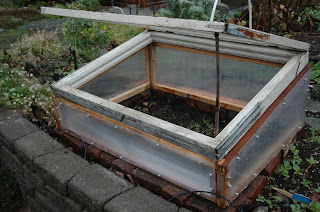

Photo: Bill Thorness
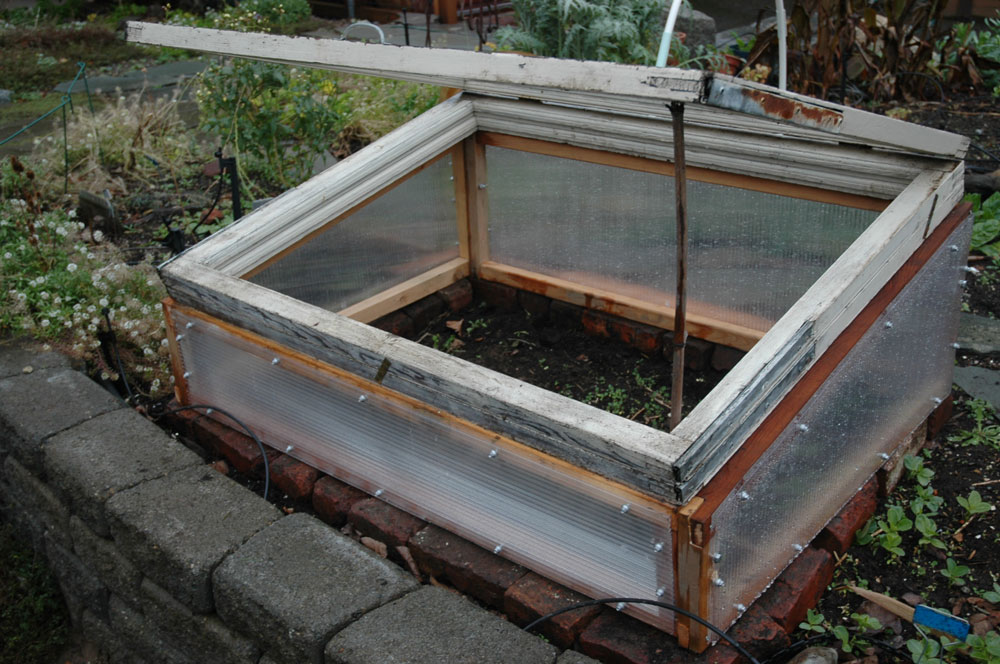
Cold frames generally have a rigid frame instead of the cloche’s flexible frame, built of wood that’s covered in glass or rigid clear plastic. The front side is at least 8 inches lower than the back side, so that the top is slanted to catch the low winter sun. [Editor note: Vern Nelson, columnist at The Oregonian has written about cold frames. Follow this link for more information.

The solid glass of an old window makes a great cold frame lid. The box can be built with 2x2 untreated wood, cut and screwed together into rectangles for the front and back, shorter in front and higher in back. The sides will be a bit trickier to cut, because you will be creating an irregular shape that accounts for the height of the front and back.

You can enclose the sides with wood, but I use polycarbonate sheet plastic. Its clear sides allow more of our weak spring sun into the cold frame. Screw the pieces of each side together, so they can be disassembled when pieces of wood rot (please don’t use treated wood). Attach the top to the back with galvanized steel hinges, and attach a cord to the top and to the side so that the top won’t fly open too far if you open it on a windy day. Keep a wedge of scrap wood or a brick handy to prop it open for venting.

Set the cold frame on a bed of bricks, situated so that the slanted lid faces the sun with the least shadow at high noon. Let the soil dry for a week or so before planting.

Bill Thorness will be speaking on Year-round Edibles: Best Growing Techniques and 10 Steps to Your Best Tomato Year Ever at the Yard, Garden & Patio Show. He is a Seattle-Based freelance garden writer and author of Edible Heirlooms: Heritage Vegetables for the Maritime Garden. He writes for numerous regional publications, including The Seattle Times, Seattle Met magazine, PCC Sound Consumer and Oregon Tilth's In Good Tilth. He also authored the guidebook Biking Puget Sound and has been a biking gardener in Seattle since the mid-1980's.

Editor Note: This inspired cold frame caught my eye at the 2010 Northwest Flower & Garden Show. It looks like a fun way to add some year round color to the veggie garden.

Tuesday, February 1, 2011

RAG Event: Behind-the-Scenes at Yard, Garden & Patio Show!

Ever wonder how the showcase gardens at the Yard, Garden & Patio Show (YGP) are built in only four days? Well readers, here’s your exclusive opportunity to get a sneak peak at the gardens as they are being built.

We’ll start the evening in the VIP lounge overlooking the showcase gardens so you can get a birds eye view. You’ll be welcomed by the show’s manager (OAN’s Allan Niemi) and volunteer YGP chair (Ken Christopherson, ProGrass). The show’s presenting sponsor Dennis’ 7 Dees Landscaping and Garden Centers has been designing YGP show gardens for years—they get more interesting and beautiful each year—and this year is no exception. You’ll hear about their design and some of the challenges they’ve encountered. Then we’ll head down to the show floor among the controlled pandemonium for a close-up look at the gardens, Curiously Cool Plant display and Incredible Edible Garden under construction (you need to sign a waiver upon registering for the event in order to have access to the show floor).
Sign up now!

 
• Wednesday, February 16, 2011
• Oregon Convention Center (take MAX; street or convention center parking is also available)
• VIP Lounge (enter at the main entrance on MLK Blvd. and take the elevator to the second floor VIP Lounge)
• 4 p.m. - 6 p.m. (“program” will begin at 4:30 p.m.)

The Yard, Garden & Patio Show opens on Friday, February 18 and runs through Sunday, February 20. Show hours are Friday and Saturday, 10 a.m. to 7:30 p.m. and Sunday, 10 a.m. to 5 p.m.