Wednesday, June 29, 2011

Why Did My Plant Die?


It’s inevitable that we lose plants along our gardening journey. But thank goodness, in spite of the many things that could go wrong, many plants survive and thrive. I consider it one of the many miracles of creating a garden.

This poem has been around for awhile but I saw it for the first time today so I thought I’d share it with you. It really needs a line or two about Barney, my adorable golden retriever, and his help in the garden…something along the lines of pulling up plants he thought were sticks, or racing around the garden with a neighbor dog oblivious to the newly planted bed(s). I wish you the antithesis of this poem in the years of gardening you have ahead of you.

Why Did My Plant Die?
Geoffrey B. Charlesworth

You walked too close. You trod on it.
You dropped a piece of sod on it.
You hoed it down. You weeded it.
You planted it the wrong way up.
You grew it in a yogurt cup
But you forgot to make a hole;
The soggy compost took its toll.
September storm. November drought.
It heaved in March, the roots popped out.
You watered it with herbicide.
You scattered bonemeal far and wide.
Attracting local omnivores,
Who ate your plant and stayed for more.
You left it baking in the sun
While you departed at a run
To find a spade, perhaps a trowel,
Meanwhile the plant threw in the towel.
You planted it with crown too high;
The soil washed off, that explains why.
Too high pH. It hated lime.
Alas it needs a gentler clime.
You left the root ball wrapped in plastic.
You broke the roots. They're not elastic.
You walked too close. You trod on it.
You dropped a piece of sod on it.
You splashed the plant with mower oil.
You should do something to your soil.
Too rich. Too poor. Such wretched tilth.
Your soil is clay. Your soil is filth.
Your plant was eaten by a slug.
The growing point contained a bug.
These aphids are controlled by ants,
Who milk the juice, it kills the plants.
In early spring your garden's mud.
You walked around! That's not much good.
With heat and light you hurried it.
You worried it. You buried it.
The poor plant missed the mountain air:
No heat, no summer muggs up there.
You overfed it 10-10-10.
Forgot to water it again.
You hit it sharply with the hose.
You used a can without a rose.
Perhaps you sprinkled from above.
You should have talked to it with love.
The nursery mailed it without roots.
You killed it with those gardening boots.
You walked too close. You trod on it.
You dropped a piece of sod on it.

Wednesday, June 22, 2011

Tips for Blueberry Success

Information courtesy of Fall Creek Farm & Nursery

Blueberry lovers rejoice! A straightforward, non-technical guide to growing blueberries anywhere in the U.S. will have you picking your favorite berries in no time. Fall Creek’s A Gardener’s Guide to Blueberries will help ensure your success with these famously unfussy shrubs.

A Gardener’s Guide to Blueberries is based on three decades of field-tested wisdom gleaned from the Brazelton family and their team of experts. Their Fall Creek Farm & Nursery in Oregon’s fertile Willamette Valley is the world’s leading wholesale producer of blueberry stock, with presence in the blueberry industries across North and South America, Europe, and Africa. In this 40-page, full-color guide, the Brazeltons share their insight and enthusiasm for what they consider the perfect plant. Their guide even offers two treasured Brazelton family recipes: Overnight Mini Blueberry Sweet Rolls and Aunt Bev’s Blueberry Muffins.


Written by the world’s leading blueberry experts at Fall Creek Nursery, the compact but comprehensive guide outlines steps to success with blueberries, from planting to plucking and everything in between. Topics include blueberry varieties, site selection, soil preparation, planting, pollination, mulching, fertilizing, watering, pruning, pests, cold protection, container plantings, troubleshooting, online resources and the health benefits of eating your blueberry bounty.

Fall Creek's Amelie Aust
Amelie Brazelton Aust, daughter of Fall Creek’s co-founders, Dave and Barbara Brazelton, oversees the company’s new product development. Fall Creek’s market research has shown that home gardeners are intimidated by blueberries. “Either they’re convinced they can’t grow them in their area, or perhaps they had planted them before but failed,” Aust says. “This simple guide offers those tried-and-true tricks we’ve shared with fruit growers for decades. We wanted to make them available to every home gardener in a way that was simple, fun and affordable.”

Aust notes that while blueberries have won a very special place in the hearts of berry-lovers around the world, they’re much more than a shrub bearing summer fruit. “They’re perfect for every season and every garden. They offer beautiful bell-shaped flowers in spring, an abundance of luscious berries in summer, brilliant foliage in fall and vibrant cane color in winter,” she says. “Blueberries come in all shapes and sizes, from dwarf varieties suitable for patio pots to tall varieties that are great for hedges.”

Fall Creek’s A Gardener’s Guide to Blueberries is available to the public at the retail price of $4.99 through select garden centers, nurseries and retail stores. It is also available through Amazon. In addition, a digital e-book version of the guide is available online now through Barnes & Noble, Smashwords, Sony Reader Store and iTunes.

Wednesday, June 15, 2011

Growing a Noble Industry

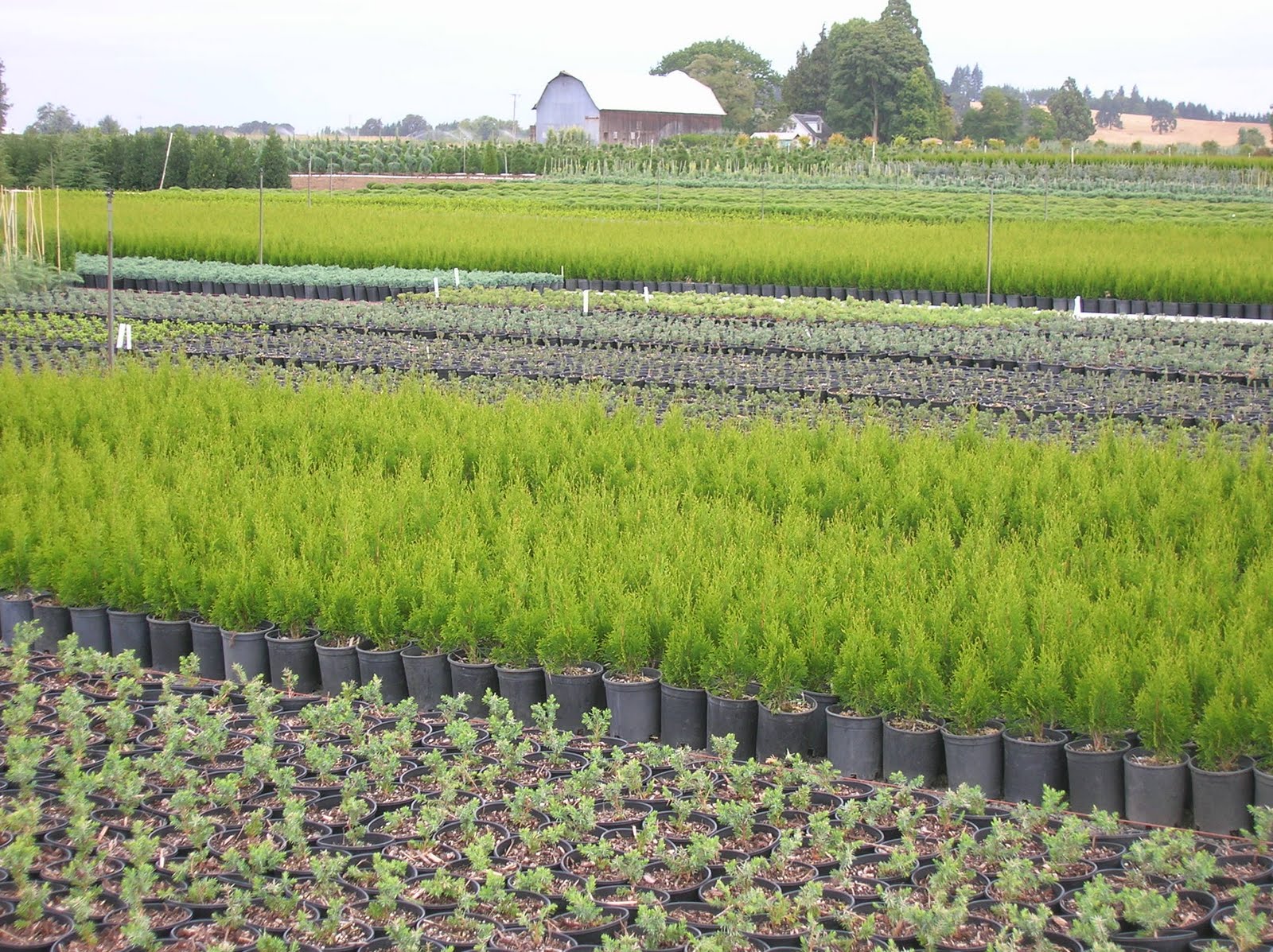
Certain areas of the country are good at growing particular crops: corn in the mid-west, citrus in Florida and California, and nursery stock (and many other agricultural crops) in Oregon. As the second largest nursery state in the country and the largest exporter of nursery stock, Oregon is a leader in the nursery industry. To be better and more profitable and to understand and minimize the impact to the environment, many Oregon growers are undertaking projects to reduce energy use, resource inputs and greenhouse gas emissions.

I thought you might enjoy reading about the efforts of a few of Oregon’s premier nurseries to make their plants even “greener.” The story comes courtesy of Edible Portland. I’m always amazed when I visit nurseries at the complexity of the industry, something most of us take for granted when we’re buying that beautiful tree, blueberry bush, perennial, annual or vegetable. My hope is that we all learn to have a greater appreciation for how our food and ornamental plants are grown.

Thursday, June 9, 2011

Great Garden Events!

There are lots of "put it on the calendar because I really want to go to this" garden event stuff happening in the coming weeks. One's that's a little further out but is "get it on the calendar" worthy is the annual American Conifer Society conference, August 4-6, at The Oregon Garden (and a five day, four night tour going to various places around Oregon, August 7-11). Click here for brochure, post meeting tour information and registration form.

Now for the best of the rest...

June 11 - Learn to Build Willow Furniture, Hughes Water Gardens, Tualatin—Class is 6-8 hours long and when you leave, you will have your own piece of willow furniture. Fee: $125 includes materials and instructions. Call 503.897.7387 to register.

June 11, 1pm - The Cutting Garden, Portland Nursery (Stark Street), Portland—A fabulous cutting garden is not limited to full sun annual plants. Linda Beutler, author of From Garden to Vase will give suggestions of great plants for bouquets for all types of garden situations. She will bring some of her inspiring bouquets to showcase different styles of arranging flowers. Click here to register for this class.

June 11, 10am - Companion Plants, Al's Garden Center, Woodburn—Learn how to interplant vegetables and flowers and herbs to attract beneficial insects. Learn which plants make effective companions.

June 11, 10am - Soil Science: How to amend your soil, Al's Garden Center, Gresham—Is your soil soggy, or full of clay? Do your plants have a hard time thriving? Attend this class and learn how to amend your soil so your plants can perform their best.

June 11 (9am-8pm) & June 12 (10am-5pm) – Berries, Brews & BBQ, French Prairie Gardens, St. Paul—Features Oregon craft brews, wines and barbeque produced by competitors from all corners of the state. Click here for more details.

June 11 & 12, 16 & 17, 18 & 19 – Strawberry Festival, French Prairie Gardens, St. Paul—U-pick strawberries, hay rides, farm animals and more. A family-friendly event that also includes strawberry shortcake and homemade strawberry pie. Visit their Website for details.

June 12, 1pm – Portable Gardens: Troughs the Easy Way, Joy Creek Nursery, Scappoose—Unlike traditional hypertufa troughs made with cement, which are heavy and require several weeks to cure, polystyrene troughs are light, fast and last for several years. Learn how to create these aesthetically pleasing and movable troughs, which are perfect for the rock gardener or anyone interested in creating miniature environments for special plants.

June 12, 1pm, Terrarium Craft, Portland Nursery (Division Street), Portland—Easy to make and a wonder to behold, terrariums are winning over a new generation of crafters and gardeners. Amy Bryant Aiello and Kate Bryant, authors of Terrarium Craft, offer up everything a beginning terrarium crafter needs to get started, from advice about tools and materials, information about plant choices and simple maintenance tips. Click here to register for this class.

June 17-19, Oregon Cactus & Succulents Show & Sale, Portland Nursery (Division Street), Portland—Find rare and hard to find specimen cacti and other succulents.

June 18, 10am-noon – Outdoor Pondless Water Features, Terra Gardens Nursery & Bark, Salem—learn how to set stone columns in place, plumbing, pump and pond liner replacement, and pump size calculation. In the stone yard.

June 18, 10am-4pm - Carol's Greenhouses & Gardens Open House, Salem—Enjoy viewing the tropical, luscious and unique plant selections (I suspect she'll have plants for sale). Wine and hors d'oeuvres will be served. RSVP to Carol at 503.399.7187 or email at cgg5135@msn.com.

June 18, 10am (Woodburn), 1pm (Sherwood) - White Hot: It sparkles by day and gleams at night...it's white! Al's Garden Center—The white garden creates romance, peace and elegance in the garden as well as luminescence at twilight. The addition of white flowers, foliage and bark is a sophisticated treatment for an entryway, courtyard, border or container. There is no better way to brighten up a shady location in the garden than incorporating white. Speaker: Lisa Annand, Landscape Designer.

June 18, 11am - Green Walls/Woolly Pockets, Garland Nursery, Corvallis—Indoors, outdoors, with limited space or no space at all, literally up a wall or down a fence, these eco-friendly pockets provide a unique gardening experience for everyone.

June 18, 10am-4pm, Flower Show, Shorty's Home & Garden, Vancouver—The Lewis & Clark District Garden Clubs in Vancouver, Wash., are holding a flower show (horticulture and design).

June 18, 10am-5pm - Railroads in the Garden, Summer Tour 2011, Portland metro area—Sponsored by Rose City Garden Railway Society, this is a self-guided tour of nine private homes with garden railroads. The gardens offer a wide diversity of garden railroads. Many of the plants used are small, dwarf, or miniature, pruned to look like full scale adult trees. There are mosses and thymes to create meadows and small blooming flowers to create a miniature world. Fee: $10/family. Tickets can be purchased at Al's Garden Center (Sherwood), Dennis' 7 Dees (all three metro locations), Hughes Water Garden (Tualatin), Yard 'N Garden Land (Vancouver), and Portland Nursery (both locations).

June 18, 10am-4pm - Over Hill and Dale: Hood River Garden Tour, Hood River—Seven diverse gardens were selected for their own distinguishing features and contrast to other gardens in the tour. You can start at any garden and go at your own pace. Local garden art will be displayed in some of the gardens. Tickets are $7 in advance or $10 day of the tour and be purchased at Waucoma Bookstore, Good News Gardening, Columbia Arts Center, and the OSU Extension Office in both Hood River and The Dalles.

June 19, 1pm - The Simple Science Behind Organics, Joy Creek Nursery, Scappoose—Being organic is all the rage these days. But is it always the best way to go? Understanding the actual science behind gardening organically will help you make wise choices. Join Leslie Gover, propagator for Joy Creek Nursery, and Patrick Peterson from Marion Ag to explore this fascinating area of study.

June 24-26 – HPSO Study Weekend, Portland—Join other garden enthusiasts for an information and fun filled weekend of gardening immersion and garden tours. Visit the Hardy Plant Society of Oregon Website for details and registration.

June 25-26, Pink Days to benefit the Breast Cancer Research Foundation, Farmington Gardens, Beaverton—Pink plants, guest speakers, live music, food, local wine tasting, children's activities, and more. Visit their website for details.

June 25, 10am-4pm - Seeding Our future Garden Tour + Art Show, Tualatin/Tigard—Explore 8 gardens featuring a mix of styles and purposes. From the whimsical to the classic, look for ideas on plants, water features, edible gardens, art and kid friendly design elements. Benefits The Foundation for Tigard Tualatin Schools. $20 tickets can be purchased from local retailers and schools. Visit http://www.foundation4smartkids.org/ for event details.

June 25, 10am - Living Walls: Easy steps to create a lush vertical garden, Al's Garden Center (all three locations)—Living walls are easy to build and add color and texture anywhere, indoors or out. Attend this class and learn how to build a wall using a pre-formed frame. You'll also learn how to plant the walls with various types of plants from succulents to herbs.

June 25, 11am-12:30pm, Year Round Vegetable Gardening, Portland Nursery (Division Street), Portland—Join Tim Lanfri, of Community Garden Creators, to learn techniques for growing and harvesting fresh produce throughout the entire year, even in the "dead of winter"! Tim will discuss topics such as timing your plantings, fall and winter growing techniques, and how to maximize your harvest without a greenhouse. Click here to register for this class.

June 26, 1pm - Big Bang Plants, Joy Creek Nursery, Scappoose—Big bang plants are extroverted plants that grab your attention and demand to be looked at. They offer a focal point in an area that needs a lift to take it from "Ho-hum" to "Wow!" Come and take a look at some big bang plants and learn how to use them effectively to add drama to your garden either as container plants or planted directly in the garden.

July 3, 1pm - Classic Hydrangeas, Joy Creek Nursery, Scappoose—Hydrangeas go mysteriously in and out of fashion on a regular basis. Yet they remain almost unparalleled in the world of shrubs for the length of their season of bloom. If you garden on a small or large plot, in the sun, part shade or in a woodland setting, there is a hydrangea that is perfect for your site. Explore the different species of hydrangea, learn easy care techniques and examine some ideal companion plants. You will never be without a hydrangea again no matter what the fashion.

July 4, 11am-4pm – 8th Annual Berry Festival, Smith Berry Barn, Sherwood—Enjoy family activities, good and live entertainment including fresh berry desserts, milkshakes and ice cream, grilled sausages, wine tasting.

July 9, 1pm - Hypertufa Pot Making Class, Bauman Farms, Gervais—Hypertufa is a new sensation in the gardening world. Handmade by you this will surely be your favorite piece in the garden. Hypertufa is made from a mixture of natural ingredients and dries up in a few days. To register, email baumans@baumanfarms.com.

July 9, 1pm - Growing Weird Plants: Cactus and Succulents, Portland Nursery (Stark Street), Portland—Luther Sturtevant of Kara Cactus will provide general guidelines for selecting succulents and cactus with an open discussion for what you need to know about growing them. Click here to register for this class.

July 10, 1 pm - What to do in the Garden in July and August, Farmington Gardens, Beaverton—New to gardening or to this area? Join this class to learn what can be done in the summer garden. Bring your questions!

July 10, 12-4 pm - Water-wise gardening, with the Regional Water Providers' Consortium, Farmington Gardens, Beaverton—Here in the Portland metro area we are fortunate to have a wide variety of spectacular native and well-adapted plants that thrive in our region. Explore their selection of water-wise plants and see how you can use them to add color, drama, and texture to your garden. Pick up a free waterwise plant guide, watering gauge kit, and other water efficient landscaping resources that will save you time, money, and water.

July 10, 1pm - The Long-Blooming Garden: Selecting and Caring for Plants that Will Give You Blooms Almost All Year Long, Joy Creek Nursery, Scappoose—When designing and buying plants for your garden, it's important to think of plants that bloom at different times of the year. Garden designers Anne Marsh and Gary Fear will discuss a broad palette of plants for year round blooming as well as pruning tips to prolong a plant's bloom cycle.

July 10, 1pm - Drought Tolerant Plants, Portland Nursery (Stark Street), Portland—Katie will highlight plants for a variety of dry situations and teach you some strategies for establishing and caring for drought tolerant plants. Click here to register for this class.

July 16 - Berry Festival, Fresh To You Produce, Stayton—Enjoy berry desserts and sampling berries, jam and syrup.

July 16, 1pm - Succulent Gardening Class, Bauman Farms, Gervais—If you made a hypertufa pot in last week's class at Bauman Farms, now is your time to fill it. We will teach you the ins and outs of succulent gardening and help you create your own fantastic planter. If you didn't make a hypertufa pot, that's okay; bring a container from home or pick one out at the farm.

July 16, 11 am - Perennials for Containers, Farmington Gardens, Beaverton—Many perennials not only adapt well to containers, they truly shine! explore with Dan Heims an array of colorful perennials and learn how to care for them. Tips on maintaining fertility and winterizing pots will be discussed. Walk away with some great "recipes" to use in your own garden.

July 16, 1pm - Unusual Shrubs, Portland Nursery (Stark Street), Beaverton—Shrubs lend structure and volume to your landscape. Paul Bonine, owner of Xera Plants, will introduce us to some of the rarer types available to make your garden really stand out! Click here to register for this class.

July 17, 1pm - Small Water Features, Joy Creek Nursery, Scappose—Having the glint of sunlight off water in your garden, as well as its liquid purl, is not difficult. Nadine Black will present ideas for adding this dimension to your garden that can be easily implemented.

July 17, 1pm - Screens for Privacy, Portland Nursery (Stark Street), Portland—By hiding unsightly views or creating a cozy private space, living screens beautifully solve common problems of the urban garden. Sean will showcase a range of options. Click here to register for this class.

July 17, 1-7pm - 'Summer Soiree' RAD Craft show, Portland Nursery (Division Street), Portland—Indie artisans and rad crafters bring you their summer collection of new styles in haute colors and must haves! From jewelry to fun and funky home décor in a Garden setting with live music and local brew! Spend an afternoon chatting and browsing sweet summer-y finds! With a variety of offerings to choose from, we're sure you'll be back for more.

August 4-6 – American Conifer Society Annual Conference, Silverton

Eight Gardens. A Million Ideas.

I spent the day with a group of landscape designers, volunteers, artists and homeowners involved in the eighth annual Behind-the-Scenes Garden Tour, set for Saturday, June 18. Eight gardens, all professionally designed, are featured on the tour. You’ll see everything from small intimate NE Portland gardens to a very large garden tucked away in Lake Oswego. Artwork by regional artists is also on display and for sale in the gardens.

Here are a few highlights to, hopefully, entice you to visit the gardens.

Dryland gardens are featured in two locations. They receive no additional water now that the plants are established. Lucy Hardiman designed her garden in three water zones: no water, once-every-three-weeks watering and a more traditional garden on a regular watering schedule. See if you can tell which is which; the plants are all lush and colorful.

Two gardens feature major rainwater capture gardens in two very different styles: a large planted concrete basin and a large swale anchoring the corner of a front garden fed by copper rain chains.

A very fragrant ‘Miss Kim’ lilac appeared in at least three gardens. It’s amazing how clusters of such small flowers scent the air with their wonderful perfume. The best plant surprise for me was the Saxifrage and its frothy blooms. The best street tree was the ‘Venus’ flowering dogwoods. The blooms were the size of my hand and the trees were loaded with them.

Yellow foliage was a popular theme (not surprising because it’s a great way to add light to the garden). It appeared in wonderful plant combinations and a golden variegated elderberry. The graceful Japanese forest grass ‘Aureola’, my favorite perennial of all time, was spectacular in many of the gardens.

Pathways and the use of different paving materials added interest to each garden. Rock seems to add a definitive and finishing touch to garden spaces (makes me want to have a dump truck deliver a load of basalt to edge paths and build low retaining walls—that would be a good workout!). Ironstone was used successfully in several places.

And the best of the rest? You’ll just have to visit the gardens to find out what appeals to you! You’ll take away lots of ideas for your own gardens and the designers and artists will be on hand to answer your questions and tell you how they overcame the challenges of each space. It’s amazing what transformations can happen!

Tickets are $20. Proceeds benefit ANLD scholarship programs for aspiring landscape designers at Clark College, Clackamas Community College and Portland Community College. Purchase tickets online or at these garden centers: Dennis’ 7 Dees (SE Portland, Cedar Hills, Lake Oswego), Garden Fever!, Magnolia Manor and Portland Nursery (Stark Street).

Wednesday, June 8, 2011

Plant Collecting

C. 'Fairy Blue' is often sold
as syn. 'Crystal Fountain'
Once upon a time, I was feeling smug about all the various plant groups I was collecting in my garden, so smug I was thinking about writing about my "collections" in Random Acts of Gardening. I was rather proud that I had accumulated 10 or so varieties of epimediums and 20 or so hydrangeas and hostas. Then I met real plant collectors that were deliberately assembling as many taxa, species and cultivars of one plant family as possible . Turns out plant collections—in essence a living museum—can help us understand the diversity and geographic dispersion of plants.

C. 'Nelly Moser' romps with a rhody
The Rogerson Clematis Collection (RCC) sits on about two acres at Luscher Farm in Lake Oswego, Ore. At approximately 500 taxa and just under 900 individual plants, it is one of the largest assemblage of clematis in the Western Hemisphere. Approximately 30% of the taxa in the collection are not currently available in the “trade” (which means you and I can’t buy them anywhere). The collection was started in the early 1970s in Kansas by Brewster Rogerson. He moved out to Oregon in 1981 to provide his collection a more hospitable environment (how’s that for devotion!). The Founder’s Garden is devoted to Mr. Rogerson’s favorite clematis, which I understand keeps growing in number.


C. 'Miss Cavell' was introduced
in 1918 and is named after a nurse
Around the historic farmhouse is The Historic Garden filled with plants that might have been available to Oregon gardeners before World War I (the plant tags show when the plants were introduced). Surrounding the historic 85 year old beech tree is a garden filled with species or hybrids from Japan, a country with a long tradition of clematis breeding focused on subtle shapes and colors. According to curator Linda Beutler, the beech tree is the only thing that “doesn’t get a clematis growing through it.”


Native C. integrefolia ochroleuca
hides behind Kitty
There are clematis that like it hot. In the south-facing Front Bank Gravel Garden, you’ll find North American natives in a genus known botanically as “the Viornae,” some of which live in oak savannah. To mimic the environment as closely as possible, volunteers collect and compost leaves from nearby oaks to add to the soils surrounding these plants. It should be no surprise that the collection is renown as a result of such devotion and attention to detail.

For the gardener just beginning to experiment with clematis, RCC is building a Beginner’s Garden that will feature 40 or so clematis selected by the International Clematis Society as varieties and cultivars that are not only beautiful, but also reliable, and easy to grow. Another garden features clematis from the Baltic (Poland, Estonia, Russia, Latvia and Lithuania) where the genus is enjoyed by avid hobbyists and plant breeders.


Best idea: Attract mason bees by creating a home that also provides support for a clematis!

The Friends of the Rogerson Clematis Collection is devoted to the preservation and continued expansion of the collection to present as fully as possible both the botany of the genus and the range of attractions that clematis have for gardeners, says the RCC’s brochure. They can use our help as volunteers and for financial support. Go for a visit and plan at least two hours to stroll the gardens with a docent. For more information, visit their website.

Pick your favorite Chelsea Garden

The Chelsea Garden Show is over for 2011. But wait! We’d like to know which gardens you think are the most interesting and intriguing. Which gardens provide you with the most ideas and inspiration? Click here, spend a few minutes looking at the garden and let us know by writing a comment your favorites (maybe your top 3 if you have the time). We’re starting to plan for the showcase gardens at the 2012 Yard, Garden & Patio Show and want to build gardens that knock your socks off and offer you ideas that can apply to your gardens at home, not always an easy balance to achieve. Sharing your favorite Chelsea garden(s) will help us. Thank you!