Monday, September 26, 2011

Persian Ironwood

Photo courtesy of Garden World
http://www.gardenworldonline.com/
Bark, structure, flower composition and color, leaf shape and fruit all contribute to make plants interesting. The “back story” can often be just as interesting and informative, too.

I planted two Parrotia persicas, commonly known as Persian ironwood, in my garden three or four years ago because I wanted the brilliant fall color I’d seen in photos (like the one the right). The structure of the trees is pleasing with or without leaves, but I have yet to see the bright fall leaf color. I thought the lack of color might be because of something I was—or wasn’t—doing. Now this is where the “back story” comes in...

In the September 2011 issue of Landscape Architecture Magazine, published by the American Society of Landscape Architects (ASLA), writer Constance Casey wrote about “Iran’s Loveliest Expat,” the Parrotia persica. The tree originates in northern Iran between the Alborz Mountains at an elevation of 3,000 feet down to the Caspian Sea. As a member of the Hamamelidaceae family, Parrotia is a relative of witch hazel, Corylopsis and Fothergilla, all of which share the same scalloped leaves and late winter flowers.

Unbeknownst to me, my Persian ironwoods should be producing early spring flowers with red stamens surrounded by chocolate-brown bracts before the leaves appear. I’ll have to pay closer attention because I’ve never noticed them before.

I was anticipating that the leaves would welcome autumn with brilliant crimson, yellow and amber color, maybe even a splash of purple. According to the article, however, not everyone gets the great fall color. Now they tell me! The trees planted in the New York Botanical Garden don’t color and they speculate that it’s due to the harsher climate. On the other hand, England’s Kew Gardens sees “an unbeatable array of autumn leaf colours.” The article goes on to say that Harvard’s Arnold Arboretum boasts the largest specimen in North American; it was planted in 1881 and shows its autumn color quite nicely. In Portland, Ore., we have the milder climate of its native habitat so we can’t blame it on harsh winters. I guess I’ll keep hoping that the leaf color will intensify as the tree matures. In the meantime, I’ll enjoy everything else about the lovely Persian expat.

Wednesday, September 21, 2011

Wonder Weeds?

Each of these definitions captures the troublesome nature of weeds:

1. A wild plant growing where it is not wanted and in competition with cultivated plants.

2. A plant considered undesirable, unattractive, or troublesome, especially one growing where it is not wanted, as in a garden.

3. A plant that is not valued where it is growing and is usually of vigorous growth; especially one that tends to overgrow or choke out more desirable plants

4. A valueless plant growing wild, especially one that grows on cultivated ground to the exclusion or injury of the desired crop.

But what if the “weed” has broad, boldly ribbed leaves (sound like a hosta?), subtle blooms from June to September, and is known to have medicinal properties? Kinda sounds like we should celebrate its ornamental value and healing qualities. The plant I just described is plantain (Plantago major). It thrives in compacted, disturbed soil, apparently like what remains of the lawn in my backyard.

I’m usually not in the mood to celebrate plantain; instead I’m more likely to take pleasure in ripping it out of my lawn and garden beds. But then I read about how it was once honored as a medicinal herb. In the Middle Ages it could be found by the side of the road—even then they had disturbed, compacted soil—and was used as a balm for sore feet. The Website http://www.herbalencounter.com/, says that to keep the feet free from blisters on long walks, put some leaves in your shoes. (The name comes from planta, Latin for the sole of the foot.)

Apparently, the leaves of the plantain contain allantoin, an emollient ingredient in moisturizers, and anti-inflammatory salicylic acid. Crushed plantain leaves have been used to soothe poison ivy rash, old wounds and insect bites. Leaves also are said to be high in vitamins and iron. I haven’t tried adding them to my diet even though an herbalist friend believes plants that we need appear in our lives. As Constance Casey writes in her column “Notes from the World of Living Things” in the September issue of Landscape Architecture Magazine, “People are already paying good money for similarly astringent dandelion greens, and traces of plantain were found in the stomachs of Northern Europe’s mummified 3rd century AD bog people.” As Casey suggests, it’s not that hard to see the plantain as beautiful if not palatable. I’ll try to remember that the next time I head into the garden and share space with the encroaching plantain.

Wednesday, September 14, 2011

Contemplation

Sometimes we get too busy—even if it’s as simple as being distracted by the last weeds that need to be pulled—and we forget to be in the moment. For me, the approaching autumn helps me slow down and be more reflective. I take time to curl up on a garden bench and watch the dragonflies bob their way between garden beds.

Last year, I acquired a piece of art that included a short poem (or quote) by Rabindranath Tagore, a mystic and winner of the Nobel Prize for literature in 1913. For some reason, it brought tears to my eyes when a first read it. Now it hangs near my front door so I see and read it every day, and every day it creates a brief moment of stillness and awe for me. I’d like to share it with you:

Faith is the bird that feels the light
and sings when the dawn
is still dark.

Enjoy the coming weeks and brief moments of glorious light and color as Earth begins to quiet herself.

Thursday, September 8, 2011

Gardening Events & Classes

EVENTS

Through September 10 – 2012 Red Carpet Plant Premier , Bauman Farms (Gervais): Rate over 150 hanging baskets as your favorites. Also view new 2012 plant introductions from growers and plant breeders such as Terra Nova Nurseries, Skagit Garden, Ball Horticulture, Proven Winners, Suntory and more. At 1:00 pm, Sat. September 10, Kym Pokorny, Laura Rowles, and Brian Bauman will do a round table of their favorite basket combinations, annuals, and perennials.

September 10
  • 10am-3pm – Hardy Plant Society of Oregon Fall Plant & Art Sale (Portland Expo Center)—One of the largest fall plant sales in the region. Many specialty nurseries, some of which are not open to the public, will be offering plants that often are difficult to find. Garden art for sale by regional artists. Free event, all welcome (fee for parking).
  • 11am-4pm – 9th Annual Tomato Festival, Farmington Gardens (Beaverton)—Sample dozens of varieties of tomatoes to find your favorites, enter our tomato contest, join in the fun in the Kid's Corner. Scheduled activities include: (9am) What to do in the Garden in September; (11am) Tomato Talk – learn which are the best varieties and how to grow them; (2-4pm) Cooking with Chef Dan, from the Oregon Culinary Institute, returns with his favorite seasonal tomato recipes. Samples and recipes included.
  • 6pm – Walk in the Garden of the September Full Moon, Dancing Oaks Nursery (Monmouth)—Smell the night blooming flowers, enjoy finger food, Airlie wines for tasting & sale, guitarists Maria Olaya and Phil Kaufmann, walking through the display gardens of Dancing Oaks Nursery. Fee: $25. Reservations required by calling 503.838.6058.

September 17
  • 9am-3pm – 14th Annual Fall Salem Hardy Plant Society Plant Sale (Polk County Fairgrounds, Rickreall)—Over 20 specialty nurseries from around the valley, artisans of garden art, and tool sharpening. Plus bring your plastic nursery pots for recycling. Free event, all welcome.
  • 10am-3pm – 7th Annual Tomato Tasting Festival, Dennis' 7 Dees (Lake Oswego location)—Taste the flavors of harvest time and make plans for next year's tomato planting! Sample new, heirloom and unusual tomato varieties and vote for your favorite.

September 24, 4pm – Wicked Bugs...and Some Good Ones, Too, sponsored by the Hardy Plant Society of Oregon (PCC Rock Creek Campus)—Nationally acclaimed author Amy Stewart who wrote about poisonous flora in "Wicked Plants" and comes to Portland to share stores about her new book "Wicked Bugs". She will be joined by OSU Master Gardener Jean Natter who will discuss the bugs we encounter living here. Fee: $10 HPSO members, $20 non-members. Registration required by calling 503.224.5718.

September 24 (Sherwood & Gresham locations) & 25 (Woodburn location) – Fall Festival, Al's Garden Center (all three locations)—Kick off fall with fun activities, including Slick's Big Time Bar-B-Que available for sale, Colorful Crape Myrtle seminars, sauerkraut making demonstrations, "Iron Planter" competitions, and enter to win a $100 gift card from Al's. Check their website for details.


Fall Harvest Festivals

Bauman Farms – Pumpkin Patch Kick-off Weekend, September 24 & 25 and into October


French Prairie Gardens – 2011 Harvest Festival, September 24-October 30.


Wooden Shoe Pumpkin Fest – October 1-31


Smith Berry Barn – Heirloom Apple Festival, October 15-16


October 15 & 16, 10am-4pm – Home Orchard Society All About Fruit Show (Clackamas County Fairgrounds, Canby)—One of the areas' largest exhibits of fall fruit varieties. See and taste many, including apple, pear, grapes, and quince. Get advice on selecting the right variety, tips on growing, pruning, and harvesting. Fee: $4 members, $6 non-members (free admission with new membership).

October 16, 3pm – Fall Color Preview Tour, Hoyt Arboretum (Portland)—Join a celebration of fall color with Curator, Martin Nicholson, on a special route designed for optimum color viewing. He'll answer all of your questions along the way. Meet at the Visitors Center, 4000 SW Fairview Blvd.

CLASSES
(unless noted, classes are free)

September 10
  • 10am – Water Gardening in Containers with Fall & Winter Interest Plants, Hughes Water Gardens (Wilsonville)—Learn to create beautiful small water features with fall and winter interest for your patio or balcony.
  • 11am – Fall Containers, The Garden Corner (Tualatin)—Get tips on how to build a fall container that will provide color through the fall season.


September 11
  • 1pm – Basics: Path Construction, Joy Creek Nursery (Scappoose)—Does your home site challenge you with changes in elevation? Have you ever wondered how professionals build paths that last for years? Co-owner Mike Smith will show you construction methods and materials used in building paths for Joy Creek Nursery's landscape clients, from the most formal to something casual for a woodland. Construction demonstration will concentrate on building informal stone steps.
  • 2pm – Mums: Our Favorite Fall Flower, Egan Gardens (Salem)—Tips on selecting and growing these traditional autumn plants.
  • 2-4pm – Preserving the Harvest, Farmington Gardens (Beaverton)—Chef Dan Brophy from the Oregon Culinary Institute will give this class on putting up your own food. Learn the basics of canning, drying, and pickling. Samples and recipes included.

September 17
  • 10am – Fall Containers, Al's Garden Centers (Woodburn and Sherwood locations)—Keep your containers looking fantastic in the fall. Let Al's Experts show you how to design and plant a beautiful container.
  • 10am-noon – Cornish Stone Wall Building, Terra Gardens Nursery & Bark (Salem)—On a recent trip to England, our hardscape professional was inspired by the beautiful, old world stone walls he saw in Cornwall and Devon counties. Join in the experience as he recreates a wall from the past. In the stone yard.
  • 10am-noon – Intro to Rain Gardens, Portland Nursery (Division Street location, Portland)—Explore the critical role rain gardens can play in restoring our urban streams, all while adding beautiful landscaping to your yard. Join expert Candace Stoughton of East Multnomah Soil & Water Conservation District, for a great introduction to the various steps involved in planning a rain garden project at your home or work place. She will also lead a fun site assessment exercise together as a group for hands-on planning experience. You will get to take home a comprehensive manual that shows all the steps to constructing a rain garden. Click here to register for this class.
  • 1pm – Edible Landscaping, Tsugawa Nursery (Woodland, Wash.)—Have you seen how blueberry foliage creates a bright and colorful fall shrub or how an espaliered fruit tree can provide an intriguing and beautiful living fence? Experts will be sharing how to incorporate some edible beauties into your landscaping. Feel free to bring in photos or a rough drawing of your yard. Register on-line.
  • 1-2:30pm – Garlic, Onions & Early Spring Planting, Portland Nursery (Division Street location, Portland)— Vegetable gardening season is winding down, yet there are still some essentials to get ready for next year! Tim Lanfri of Community Garden Creators will discuss what veggies you can still plant, and how to prep your garden space for early spring plantings. Fall is the perfect time to plant overwintering garlic, onion and shallot sets, and Tim will share his years of growing experience to help you maximize your success! He will also walk you through the essential steps of preparing your beds in the fall so you can plant earlier in the spring and avoid digging and destroying your soggy spring soil. Topics will include amending, composting, prepping and protecting your beds. Click here to register for this class.

September 18, 1pm – Designing for Conifers, Joy Creek Nursery (Scappoose)—Learn the qualities and characters of dwarf conifers and come to appreciate how they can function as shrubs in a home garden. Susan LaTourette, landscape designer, will share her experiences growing some of her favorite dwarf conifers and show examples of plant combinations that can provide year round interest.

September 24
  • 10am – Building Ponds and Waterfalls, Hughes Water Gardens (Wilsonville)—Tips and ideas on building your own pond and waterfall.
  • 10am – Bonsai Basics, Dennis' 7 Dees (Seaside location)—For the beginning to intermediate bonsai enthusiast, this hands on workshop will outline in straightforward fashion the essentials of the care, creation and display of these lovely pieces of art. You, too, can become a Bosai Master! Starter kits will be available starting around $25.00 each.
  • 11am – Bonsai Collections of the Pacific Coast, Tsugawa Nursery (Woodland, Wash.)—Join Gregor Buel for an interesting and informative presentation on some of the beautiful bonsai collections he has had the privilege to visit throughout Washington, Oregon and California. Register on-line.
  • 1pm – Fall Containers, Tsugawa Nursery (Woodland, Wash.)—Are your containers overgrown? Out of hand? It's time to rip out the old, and plant something new! Their container professionals will share some great plants that will get your container gardens flourishing through fall and into the winter months. Register on-line.
  • 1pm – Creating Fall & Winter Interest Containers, Portland Nursery (Division Street location)—Take home a stunning container that will wow your holiday guests and brighten up the darkest of winter days! Learn how to put together a container with lasting color and seasonal interest plants in this hands-on workshop led by Jolie Grindstaff. Class will cover the basics of container design, offer planting and maintenance tips, and guides you in your own creation of a 10" planter. Please bring gloves and a trowel. All other supplies provided. Fee: $30. Please pay cashier before class. Click here to register for this class.
  • 1pm – Holiday Edible Container, Portland Nursery (Stark Street location)--Maggie Stuckey, author of The Bountiful Container, will show you how to put together a container garden with plants that you can integrate into your festive fall and winter dinners. Make your holidays extra special by serving something you've grown yourself, even if your only growing space is a container. And one lucky person will take home the demonstration container! Maggie will be signing copies of her book after class. Click here to register for this class.

September 25
  • 1pm – Pruning 101, Garland Nursery (Corvallis)—To keep healthy trees, fruits and shrubs, you need to keep them pruned. Our knowledgeable staff will cover pruning of fruit trees, Japanese maples, roses, and hydrangeas. We will share the best techniques to keep your plants growing healthy and strong. Registration is required and space is limited. Call 541.753.6601 to register.
  • 1pm – Winter Containers for Year-Round Interest, Joy Creek Nursery (Scappoose)—Basic container maintenance and a strong design element are essential to having breathtaking containers throughout the winter. Create a winter container combination that will delight you through the cold weather months and the year ahead.
  • 1pm – Planting Bulbs Now for Spring Blooms, Portland Nursery (Division Street location)—Brighten your garden using stunning spring-blooming bulbs with the help of Mark Hopkins of Van Bloem Gardens. Mark will discuss the basics of amending, planting, and fertilizing as well as tips for tricky areas (shade, wet soils). He will go over planting for extended bloom & fragrance, the best varieties for containers and cut flowers, and layering techniques for a big impact. He will do a planting demo layering bulbs in class, and one lucky person will get to take the pot home! Click here to register for this class.

October 1, 10am – Aromatherapy in the Garden, Dennis' 7 Dees (Seaside location)—Gardeners
have been practicing aromatherapy for hundreds of years. Whether just by planting fragrant creeping thyme along a wall, a planter box of scented geraniums or a gourmet kitchen herb garden, one is treated to an exceptional aromatic experience. This class will also touch on the medicinal value of essential oils derived from your garden favorites!


October 8
  • 10am-noon – Beginning Bonsai, Terra Gardens Nursery & Bark (Salem)—Class includes Instruction, Bonsai starter tree, a pot, a book, and the tools and supplies needed to get the tree started. Come join us for a fun and interesting journey into the world of Bonsai. Fee: $40 pre-registered or $45 at the door. All tools and materials supplied.
  • 11am – Introduction to Bulb Displays, Dennis' 7 Dees (Cedar Hills location)—Learn how to pair a variety of bulbs for a glorious floral spectacle that will last all spring. The focus will be planting long-lasting bulb displays in pots with ideas for fall/winter planters so you don't have to look at barren pots all winter. Plus tips on what plants will keep planters looking fresh till your bulbs burst to life. Bring your bulb questions for the Q&A session. Register at the Cedar Hills store. Fee: $25 (after attending the class you'll receive a $25 coupon to spend on pottery, soil and bulbs).
  • 11am – The "Magic" Terrarium, Dennis' 7 Dees (Seaside location)—Terrariums are wonderful & magical environments. Decorative, attractive and easy to care for, just plant and forget. A closed terrarium can often go a month between watering. Now even those of you who tend to neglect plants can develop a green thumb. This hands-on workshop will walk you through the easy steps of creating your own terrarium. Bring your own glass container or purchase one at the nursery. A variety of miniature plants starting at $2.99 will be available for purchase and the potting soil is complimentary!

October 15, 10am – Fall Bulbs for Spring Color, Dennis' 7 Dees (Seaside location)—Okay, let's get this straight...Spring flowering bulbs are called "fall bulbs"? That's exactly right! One of Karen's favorite gardening chores is to plant her spring color on a sunny crisp fall day! Learn how to lay out your flower garden, so that it blooms from late February to early May, and what fertilizers to use to give them that extra boost!

Wednesday, September 7, 2011

New Plants

New seems to be the mantra of the nursery industry these days, even though there are lots of wonderful plants that have proven themselves in the landscape. But new captures people’s attention and imaginations and plant breeders and growers are determined to deliver.

The New Varieties Showcase was filled with 51 new varieties this year at the 2011 Farwest Show, produced by the Oregon Association of Nurseries and one of the nation’s largest wholesale trade shows. These varieties will be found in garden centers this fall and in spring 2012.

Flutterby Grandé™ Peach Cobbler
Nectar Bush
Judged to be “Best in Show” was Flutterby Grandé™ Peach Cobbler Nectar Bush (Buddleia x ‘Podaras #5’ PPAF) from Ball Ornamentals. This choice reflects the importance of Buddleia as part of the sales mix for Oregon nurseries. It is certified by the Oregon Department of Agriculture as sterile, which means Oregon nurseries can add Buddleia back into their growing inventory. The wonderful fragrance, full-sized inflorescences and silvery leaf color would be welcome in any garden. The fact that the plant also attracts pollinators, a popular gardening trend, is an added bonus. One garden center owner said home gardeners really want the intense color of past Buddleia cultivars that Oregon nurseries can no longer grow. I’m sure those colors will appear in future sterile varieties at some point. In the meantime, Peach Cobbler offers me the soft sunset-like colors I enjoy throughout my garden.

Sombrero Salsa Red Coneflower
The overwhelming favorite of those visiting the New Varieties Showcase was Darwin Perennial’s Sombrero Salsa Red Coneflower (Echinacea hybrida ‘Sombrero Salsa Red’ PPAF). I must admit, the plants in the showcase were stunning.

Solar Eclipse Foamflower
Other favorites of mine were Blonde Ambition Blue Grama Grass (Bouteloua gracilis ‘Blonde Ambition’ PPAF) grown by Blooming Nursery (an adorable grass with brush-like flowers); Solar Eclipse Foamflower (Heucherella ‘Solar Eclipse’ PPAF, EU-derived variety) from Terra Nova Nurseries (wonderful red-brown leaves rimmed in lime green); Sparkler® Willow-Leaf Stachyurus (Stachyurus salicifolia ‘MonEmeri’) from Monrovia (strappy, leathery foliage); and You-Me Passion Hydrangea (Hydrangea macrophylla ‘Rie 4’ USPP #16653, COPF) from PlantHaven (sweet double blooms).

To see Kym Pokorny’s favorites, garden writer for The Oregonian, visit her blog Dig in with Kym.

Tuesday, September 6, 2011

Readers Tour Farwest Show

Richard Bitner in the
Conifer Display
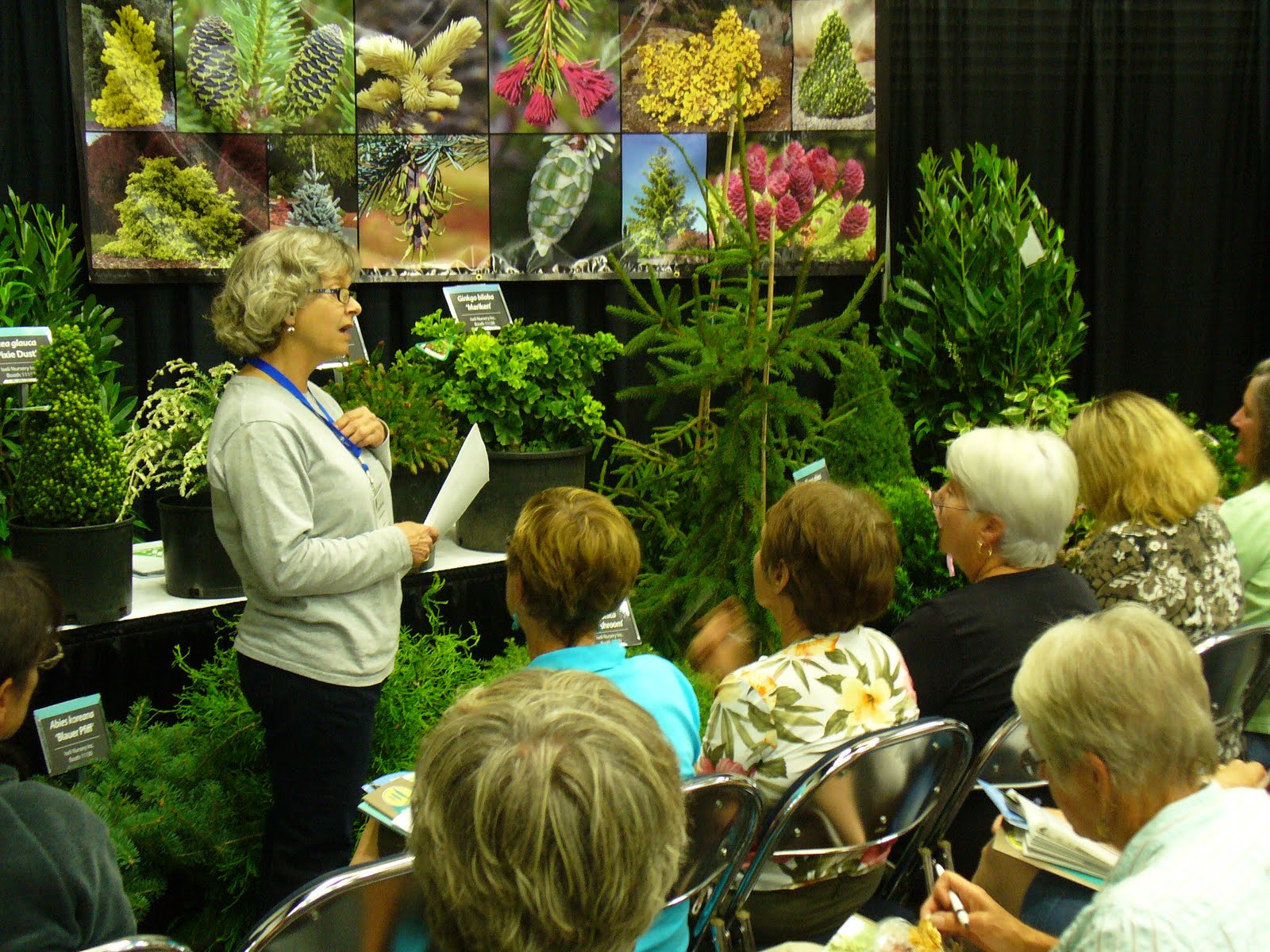
The Farwest Show wrapped up last week. It’s produced by the Oregon Association of Nurseries and is one of the largest wholesale trade shows in the country. Some of our Random Acts of Gardening readers got a tour of the show, which focused this year on conifers, one of my favorite family of plants. They met Richard Bitner, author of several books on conifers, who answered some of their questions (we didn’t have nearly enough time to answer them all). Eric Bizon, grower for Bizon Nursery and someone that’s passionate about conifers, showed the group some of his favorites at his booth (Bizon Nursery is one of the suppliers to Garden World in Hubbard). Carol Nehring, Iseli Nursery, spoke on "Conifer Chameleons: Choosing Conifers with Seasonal Interest," which are listed below.:

Eric Bizon, Bizon Nursery,
sharing some of his favorite conifers
Pinus contorta ‘Chief Joseph’ – bright yellow winter color
Chamaecyparis obtusa ‘Lemon Twist’ – new foliage is a warm, rich yellow
Picea pungens ‘Hoopsii’ – bright silver-blue needles year round
Abies koreana ‘Blauer Pfiff’ – colorful cones and low, spreading habit
Picea abies ‘Rubra Spicata’ – deep red new growth
Tsuga canadensis ‘Albospica’ – showy white tips
Pseudotsuga menziesii ‘Blue’ – a clear blue Doug Fir
Ginkgo biloba ‘Mariken’ – dense fan-shaped foliage and yellow fall color

Carol Nehring, Iseli Nursery, talks
about conifers with multi-season
interest
  • Picea glauca ‘Pixie Dust’ – new yellow growth contrasts with deep green mature foliage
Picea orientalis ‘Aureospicata’ – chartreuse new growth
Picea abies ‘Pusch’ – bright red cones
Cryptomeria japonica ‘Mushroom’ – russet winter color
Juniperus communis ‘Kalebab’ – light green undersides and white tops in spring, medium green summer color changes to bronze in autumn, in winter foliage turns orange-yellow
Pinus contorta ‘Taylor’s Sunburst’ – golden yellow new growth and red cones

Dave Grotz, Peace of Mind Nursery,
shares his enthusiasm for conifers
Then there was a brief stop at Peace of Mind Nursery where owner Dave Grotz showed everyone the conifers in his booth (he has two locations—West Linn and Silverton—that are open to the public by appointment; and check out his photo gallery which is very informative). Finally, the group was turned loose in the New Varieties Showcase. We plan to do the tour again next year so stay tuned!

Monday, September 5, 2011

Fall Veggie Plans


I’m ready to pull out the some of the summer veggies that have bolted or withered and plant my fall and winter crops. One of my co-workers passed this Lettuce Pots blog link along to me and it made me think how fun it would be to have a brunch or dinner party and use smaller pots stuffed with lettuce as centerpieces, something that would be decorative and edible.

If you’re as new to food gardening as I am, Independence Gardens might be a helpful resource for you. Their regular emails and blog are very helpful and they can help you develop a plan for crop rotation to maximize your gardening space (you just have to tell them what fruits and vegetables you like to eat).

I have beans to pick, the tomatoes are ripening (finally!), onions are begging to be pulled out of the ground, fava beans are growing pods like mad, and the kale I planted in the spring is still looking good and is ready for another round of harvesting. The only disappointment this year was the Romanesco cauliflower, which didn’t make the beautiful tight heads I anticipated, and the basil I planted in the ground that is about the same size as when I planted it months ago (the basil in the containers did just fine).

Are you going to try something new in your fall vegetable garden?

Friday, September 2, 2011

Question: What is 750?

Answer: The estimated number of tree species that are native to North America.

Oregon's McKenzie River
I’m an unabashed tree lover and tree hugger (literally). I wish I had a bigger yard so I could plant more trees (good thing I like the shady plant palette and a woodland environment is one of my favorites, because I have LOTS of shade!). Even though I love trees, I’m not very good at tree identification.

Trees are indentified by studying their leaves, seeds, and fruit. If, like me, you are tree identification challenged, there are some fun and wonderful tools at your disposal. The Arbor Day Foundation makes tree identification fun for the kids and grandkids, too! Check out their animated version of mystery tree identification.

Southern Oregon's Rogue River
Oregon State University has its own version of “What tree is that.” The site also lists the common trees found in the Pacific Northwest. Each genus page also includes descriptions of the species that occur, within each of the 56 genus, that are native to this region.

In the words of J. Frank Schmidt & Son Co., one of the largest wholesale nurseries in Oregon and bare root tree growers in the country: Trees are the Answer!

Question: When is the best time to plant at tree? Answer: Twenty years ago. The next best time is today!

What’s your favorite tree? Personally, I can’t decide...

Thursday, September 1, 2011

Milk. It does a [plant with powdery mildew] good.

Photo: gardener.wikia.com
If you see powdery-looking patches on the foliage of your plants, or leaves that look like they have been dusted with flour, you are most likely looking at powdery mildew fungal disease. Rarely fatal, it is unattractive and stresses the plant. If enough of the leaf surface is covered in the mildew, photosynthesis will be impaired, a particular problem with edibles because it can affect crop production and quality. Lilacs, crabapples, phlox, monarda, roses, grapes, squash and cucumbers are all susceptible; look for resistant varieties.

According to OrganicGardening.about.com, “Powdery mildew fungi are host-specific, meaning the different powdery mildew fungi infect different plants. The powdery mildew on your lilacs will not spread to your grapes or your roses.” Conditions that encourage the fungi’s growth and spread include dampness or high humidity (watering in the morning rather than after noon will help), crowded plantings and poor air circulation.

Once plants are infected with powdery mildew, OrganicGardening.about.com recommends the following:
• Remove and destroy all infected plant parts.
• Improve air circulation by thinning and pruning.
• Don’t fertilize until the problem is corrected. Powdery mildew favors young, succulent growth.
• Don’t water plants from above.
• Apply a fungicide: There are many fungicides available. Check the label to be sure they are safe and effective on the type of plant that is infected. Look for ingredients such as: potassium bicarbonate, neem oil, sulfur or copper, or use home remedies using milk, baking soda or other readily available kitchen ingredients.

Researchers in Bazil found that weekly sprays of milk controlled powdery mildew in zucchini just as effectively as synthetic fungicides. They also found that milk acted as a foliar fertilizer, boosting the plant’s immune systems. A concentration of 10-30% significantly reduced the severity of powdery mildew by 90%. Scientists aren’t 100% sure how milk works to control powdery mildew; it appears to be a natural germicide and possibly boosts the plant’s immune system to prevent the disease.

Sharon Sweeny wrote in “Dealing with Powdery Mildew – 7 Home Made Remedies that Really Work” that before using any natural remedies, plants should be hosed off “to remove as much mildew from the surface as you can. Be sure to cover all parts of the plant with the treatment spray, including the undersides of the leaves and the stems. Spray some on the soil around the plant as well. Finally, spray for mildew early in the morning before the sun rises too high in the sky. Spray plants once or twice a week in dry weather and more often if rainy.”

Milk-based recipe: Real Simple magazine (Sept. 2011) – 1 part skim milk to 9 parts water. Spray on plants dotted with powdery mildew. Repeat weekly to keep leaves fungus-free. [Note: Skim milk has no fat content so there is less chance of odors.]

Baking soda recipe: Mix 1 gallon of water, 1 tablespoon of baking soda, 1 tablespoon of vegetable oil and 1 tablespoon of dishwashing liquid or castile soap (e.g., Dr. Bronner’s). Mix the ingredients together and add them to a spray bottle. Spray weekly.